Introduction
Why Does Sleep Feel Different in Hotels?
Almost everyone has had this experience. You check into a hotel, lie down for the first time, and within minutes you are more comfortable than you have been in weeks. The bed feels right. The pillows somehow feel exactly the way a pillow should. And for a few nights, sleep comes easily and the mornings feel genuinely rested.
Then you come home, lie down on your own bed, and wonder what the difference was.
A lot of people assume it is the mattress. Sometimes it is. But the pillow plays a larger role than most people realise. Hotel pillows are typically designed to create an immediate, consistent impression of softness and loft a feeling that communicates comfort before a single hour of sleep has passed. The hospitality industry has spent considerable effort engineering that first-touch sensation.
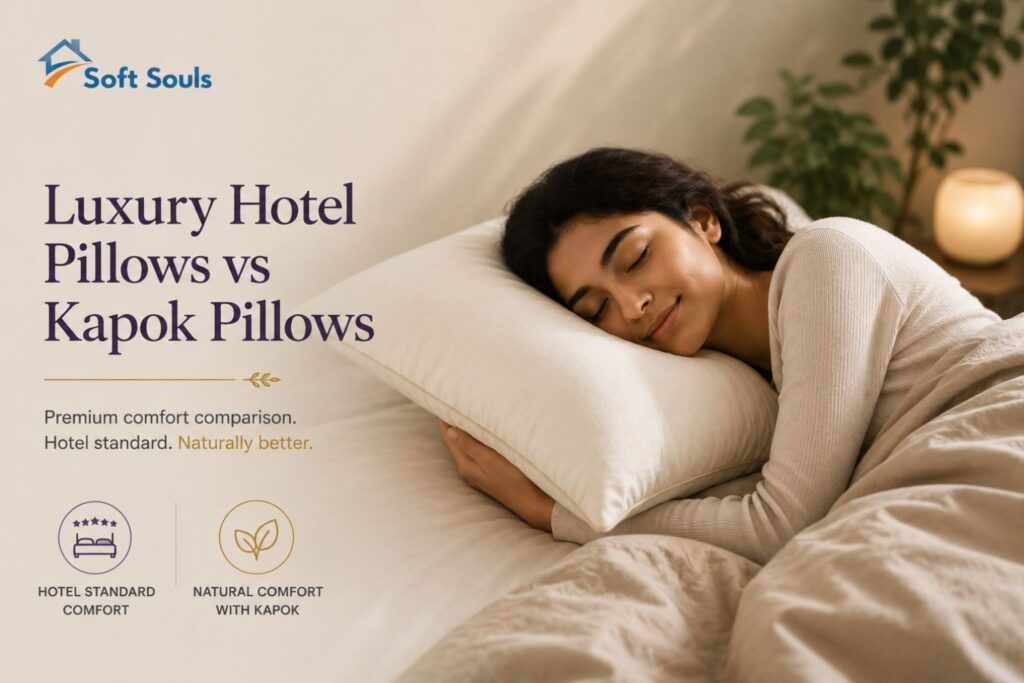
The question worth asking is whether that engineered impression translates to genuinely good sleep and whether a natural alternative like kapok can deliver similar or better comfort for everyday Indian conditions. The luxury hotel pillows kapok comparison is not just about which one feels more luxurious in the moment. It is about which one actually supports better sleep night after night.
This guide compares hotel style pillows and kapok pillows across every dimension that matters softness, support, breathability, sustainability, and long-term value.
What Makes Luxury Hotel Pillows Feel So Comfortable?
Why do hotel pillows always seem more comfortable? The honest answer is partly material and partly circumstance.
The material side is real. Quality hotel pillows typically use high fill power down or premium down-alternative fill polyester microfibre engineered to mimic the lofty softness of down at a lower price point. These fills create an immediate plush softness that is genuinely pleasant to the touch and provides enough loft to feel supportive without feeling firm.
The layered approach is also part of the formula. Many luxury hotels use two pillows per sleeping position one firmer pillow beneath for support, one softer pillow on top for surface comfort. The combination creates a layered, luxurious feel that a single standard pillow does not replicate.
The circumstance side is also worth acknowledging. Hotel sleep is often associated with relaxation, vacation, or a break from routine. The novelty of a different environment, clean fresh bedding, no household responsibilities, and the psychological permission to rest properly all of these contribute to the perception of better sleep. The pillow alone is doing only part of the work.
Hotel bedding standards are also designed for immediate impression rather than sustained performance. A hotel pillow that creates a plush first-touch experience serves its purpose whether or not it maintains that feel through the night. For everyday home use, sustained comfort across 7–8 hours and across hundreds of nights matters more than the first impression.
What Is a Kapok Pillow?
Kapok is a natural, plant-based fibre harvested from the seed pods of the Ceiba pentandra tree known in South India as the Ilavam tree, where the fibre carries the Tamil name Illavam Panju. When the pods ripen, they burst open to release clusters of silky, cream-coloured fluff. This fluff is collected and used as a pillow fill.
The defining physical property of kapok is that each fibre is hollow. This hollow structure creates continuous internal air channels throughout the fill allowing heat to escape and moisture to pass through rather than accumulating. The texture is silky and smooth, the weight is noticeably lighter than synthetic alternatives, and the feel is gently yielding without being limp.
As natural luxury pillows go, kapok occupies an interesting position. It is not engineered to create a dramatic first impression the way premium hotel fill is. Its comfort is quieter more airy, more breathable, more genuinely suited to Indian sleep conditions rather than immediately plush.
Kapok has been used in South Indian homes for generations as a traditional sleep material. Its current resurgence reflects a growing recognition that its natural properties which traditional households valued practically are exactly what modern sleep research also supports.
Luxury Hotel Pillows vs Kapok Pillows: Quick Comparison
| Feature | Luxury Hotel Pillows | Kapok Pillows |
| Softness | Plush, immediately soft, cloud-like | Silky, light, airy different softness profile |
| Support | Moderate varies by fill type and hotel spec | Soft to moderate gentle resilience |
| Breathability | Moderate (down-alternative) to poor (foam-core) | Excellent hollow fibre allows continuous airflow |
| Temperature Regulation | Variable down retains heat in warm rooms | Low heat retention suited for Indian conditions |
| Durability | 1–2 years typical for hotel-standard down-alternative | 3–5 years with care |
| Maintenance | Machine washable (down-alternative); specialist wash (down) | Sun-air fill; machine wash cover |
| Sustainability | Low-moderate (synthetic fill or animal-derived down) | High plant-harvested, biodegradable |
| Allergy Friendliness | Variable down can trigger reactions | Excellent hypoallergenic, low dust mite affinity |
| Long-Term Comfort | Degrades faster fill compresses or loses loft | Maintains airy structure longer with fluffing |
How Do Luxury Hotel Pillows Achieve Their Signature Feel?
Down and Down-Alternative Fillings
The most common filling in quality hotel style pillows is either genuine goose or duck down or a high-quality polyester microfibre designed to mimic down’s properties. High fill power down (600+) creates a lofty, plush pillow that compresses gently and springs back. Premium down-alternative microfibre achieves a similar initial feel at lower cost and without down’s allergy concerns.
Loft and Plushness
Hotel pillows are typically over-filled relative to what is needed for practical support. This creates the characteristic visual loft the plump, inviting appearance and the generous softness that makes lying down feel immediately comfortable. The priority is sensory impression.
Pressure Relief
The soft, yielding surface of down and high-quality microfibre distributes pressure across the head and neck contact area. This reduces the feeling of pressure points and contributes to the sense of being gently cradled.
Hotel Bedding Standards
Hotels replace bedding more frequently than home users typically do. A hotel pillow that is one year old is already being considered for replacement in quality establishments. This means hotel guests are often experiencing pillows that are still in their best functional state — which contributes to the performance impression.
How Does Kapok Compare in Everyday Sleep?
Soft Yet Supportive Feel
Kapok’s softness is different from hotel down softness. Down is dense and plush you sink into it. Kapok is airy and silky it cradles gently without deep compression. For some sleepers, the lighter feel of kapok is more comfortable than the denser cloud-like feel of premium down. For others, the plush impression of hotel down is the specific experience they are looking for.
Lightweight Structure
A kapok pillow weighs noticeably less than a premium down or down-alternative pillow. This reduced weight means less pressure at the head and neck contact point which for some sleepers reduces the localised warmth and morning stiffness that heavier pillows can contribute to.
Natural Airflow
This is where kapok pillow comfort has a clear, practical advantage over most hotel pillows. The hollow fibre creates continuous internal ventilation heat generated near the head escapes through the fill rather than accumulating. In hotel environments with strong AC, this difference matters less. In Indian home conditions warm, often humid, with variable cooling it matters considerably.
Adjustable Comfort
Some kapok pillows allow fill adjustment adding or removing fill to customise loft and firmness. This is a genuine advantage over fixed-fill hotel pillows, which offer no personalisation.
Which Pillow Sleeps Cooler?
Why Heat Buildup Matters
Can a natural pillow deliver the same luxury feel without the thermal discomfort? For Indian sleepers, this question comes down to what happens after the first 30 minutes. A pillow that feels wonderful initially but retains heat and moisture through the night is not delivering sustained comfort.
Hotel Pillow Temperature Performance
Premium down hotel pillows retain heat. Down’s insulating property what makes it valuable for warmth in cold climates works against sleepers in warm Indian conditions. Down-alternative polyester fill retains less heat than foam but more than hollow natural fibres. In well-cooled hotel rooms (typically maintained at 20–23°C), this heat retention is manageable. In a typical Indian home bedroom without similar cooling, it becomes a meaningful discomfort factor.
Kapok Pillow Breathability
The hollow fibre structure of kapok allows consistent airflow through the fill. Body heat generated near the head escapes rather than accumulating. The moisture-resistant fibre surface keeps the fill drier in humid conditions. The result is a pillow surface that stays relatively cooler through the night without any engineered cooling technology.
Performance in Indian Weather
For premium sleep pillows suited to Indian conditions specifically:
- Hot sleepers Kapok’s hollow fibre ventilation directly addresses heat buildup; hotel down-alternative retains warmth that a non-AC Indian bedroom amplifies
- Humid climates Kapok’s moisture-resistant fibre stays drier; down and down-alternative both absorb moisture more readily
- Non-AC bedrooms The thermal performance gap between kapok and hotel-style fill is most pronounced in non-AC conditions; kapok is the more comfortable choice
Comfort Comparison: Side-by-Side Analysis
| Comfort Factor | Luxury Hotel Pillow | Kapok Pillow |
| Softness | Dense, plush, immediately impressive | Silky, airy, lighter feel quieter softness |
| Neck Support | Moderate depends heavily on fill quantity | Soft gentle resilience; adjustable in some products |
| Pressure Relief | Good dense fill distributes pressure | Good lightweight fill avoids concentrated pressure |
| Shape Retention | Good when new; degrades within 1–2 years | Maintains airy structure with regular fluffing |
| Adaptability | Limited fixed fill; position changes require repositioning | Good lightweight fill redistributes easily with movement |
Analysis:
Hotel pillows excel at the initial comfort impression the plush, enveloping softness that creates a strong first-touch experience. Kapok delivers a different quality of comfort lighter, more airy, and more consistent over time. Which feels more comfortable depends partly on personal preference and partly on sleeping conditions.
For sleepers in Indian conditions warm, sometimes humid, often without strong cooling kapok’s thermal comfort advantage becomes increasingly apparent over a full night compared to hotel-style down or down-alternative fill.
Which Pillow Offers Better Neck and Head Support?
Side sleepers need sufficient loft to fill the space between the shoulder and ear, maintaining neutral cervical alignment. Quality hotel pillows with generous fill power down provide this comfortably. Kapok with a fuller fill or adjustable-fill option can also provide adequate loft for side sleeping.
Back sleepers generally need medium loft and soft support. Both hotel pillows and kapok are comfortable for back sleepers. Kapok’s lighter weight reduces the pressure concentration that heavier fills create.
Combination sleepers who shift positions frequently benefit from a fill that redistributes easily without noise. Kapok’s lightweight, silent fill adapts smoothly with movement an advantage over hotel down, which can bunch or shift unevenly.
Stomach sleepers typically need the lowest, flattest profile. Kapok’s soft, adjustable fill is often more comfortable for stomach sleepers than a generously lofted hotel pillow that forces the neck into extension.
For specific neck pain or medical cervical support requirements, neither hotel-style soft fill nor kapok provides the firm, structured support that a physiotherapist might recommend. In those cases, natural latex or an orthopedic pillow may be more appropriate.
Sustainability Comparison
Environmental Impact of Luxury Hotel Pillows
Hotel-standard down involves commercial poultry farming, with associated land use, water consumption, and in some supply chains animal welfare concerns around live plucking. The hospitality industry’s high replacement frequency also generates significant volume of pillow waste.
Down-alternative polyester fill is petroleum-derived, non-biodegradable, and sheds microplastics during washing. When hotel pillows are replaced, they typically enter the solid waste stream as non-decomposable synthetic waste.
Sustainability Benefits of Kapok
Kapok is harvested from naturally falling seed pods. No trees are cut. No synthetic pesticides or fertilisers are used. The fibre requires minimal processing. It is fully biodegradable. The lifecycle footprint is among the lowest available for any pillow fill material.
Durability and Long-Term Value
Hotel-standard down-alternative pillows typically maintain their best performance for 12–18 months. Quality hotels replace them on this schedule. For home users, a hotel-equivalent down-alternative pillow purchased at retail will compress, lose loft, and reduce in comfort within a similar timeframe.
Kapok pillows, maintained with regular daily fluffing and periodic sun-airing, typically retain their useful structure for 3–5 years. The hollow fibre is resilient when cared for it does not compact into a dense layer the way polyester staple fill does.
From a long-term value perspective, a kapok pillow that lasts 4–5 years represents better cost-per-use than a hotel-equivalent down-alternative that needs replacing every 18 months even if the purchase price is comparable.
Allergy and Sensitivity Considerations
Down pillows carry a known allergy risk for people sensitive to feather proteins. Down-alternative polyester is generally hypoallergenic but may contain synthetic residues from processing. Hotel bedding is laundered regularly, but the fill material itself is not easily sanitised.
Kapok is plant-based and naturally hypoallergenic no feather proteins, no synthetic residues, and lower dust mite affinity than synthetic fill. For sleepers with dust sensitivities, skin reactions to synthetic materials, or mild feather allergies, kapok’s natural composition is the more considered choice.
Who Should Choose Luxury Hotel Pillows?
- Sleepers who specifically want the dense, plush softness associated with premium hotel beds
- Those who sleep in well-cooled environments where heat retention is not a concern
- People who value the immediate visual loft and “cloud” feel of down or premium microfibre
- Occasional special-occasion purchases where the luxury impression matters more than long-term performance
- Those who do not have feather allergies and prefer down specifically
Who Should Choose Kapok Pillows?
- Eco-conscious sleepers who want a material with a genuinely clean environmental profile
- Hot sleepers dealing with Indian summer conditions particularly without strong AC
- People who prefer lighter, airier comfort over dense, plush softness
- Those with dust allergies or sensitivity to synthetic materials
- Sleepers looking for a natural luxury pillows option that performs consistently over years of daily use
- Anyone interested in traditional Indian sleep materials being rediscovered for their practical properties
Can Kapok Deliver a Luxury Hotel Sleep Experience?
Directly: yes and no, depending on what is meant by “luxury.”
If “luxury” means the specific plush, cloud-like, over-filled softness that high-end hotels engineer for first-touch impression kapok does not replicate that. The feel is different: lighter, more airy, silkier. It is not a lesser experience it is a different one.
If “luxury” means genuinely comfortable sleep, sustained through the night, without overheating or morning stiffness from a pillow that compressed during the night kapok delivers that more consistently for Indian conditions than most hotel style pillows do outside of a strongly cooled hotel environment.
The comparison is not between luxury and budget. It is between two different comfort philosophies: engineered immediate impression versus naturally suited sustained comfort. Both are valid. Which one better serves the sleeper depends on their conditions, preferences, and priorities.
Buying Guide: How to Choose
Sleeping Position
Side sleepers needing significant loft: consider fuller-fill kapok or a down-alternative hotel-equivalent. Back and stomach sleepers generally find kapok’s standard fill comfortable without adjustment.
Temperature Preferences
For warm sleepers, non-AC rooms, or humid Indian conditions: kapok’s thermal performance is the more practical choice. For cool environments with strong AC: the temperature advantage of kapok is less decisive, and hotel-style softness becomes a more relevant preference.
Sustainability Priorities
For eco-conscious buyers, kapok’s clean lifecycle is clear and verifiable. Down-alternative synthetic fill does not offer equivalent environmental credentials.
Comfort Expectations
For the specific plush hotel impression: look for high fill power down-alternative options. For everyday natural comfort with long-term consistency: kapok is the more reliable daily choice.
Budget Considerations
Hotel-equivalent down-alternative pillows at retail range widely in price. Kapok pillows at a comparable quality level offer better cost-per-year when lifespan is factored in. The genuine luxury pillow comparison for Indian buyers is not just purchase price it is the cost of the experience per comfortable night over the pillow’s useful life.
Soft Souls Natural Sleep Comfort for Indian Homes
For those exploring natural luxury pillows designed with Indian conditions as the starting point, Soft Souls (softsouls.in) is a brand worth knowing.
Soft Souls is an Indian sleep brand that handcrafts pillows using 100% pure natural Kapok (Illavam Panju) fibre wrapped in breathable organic cotton fabric. Every pillow is made by Indian artisans a combination of traditional craftsmanship and practical everyday design focused on the comfort that Indian weather and Indian sleep conditions actually require.
Their range includes:
- Standard and queen-size kapok pillow collections 100% pure Illavam Panju fill; lightweight, silky, airy, hypoallergenic, and chemical-free; designed for daily comfort in warm and humid Indian conditions
- Kids kapok pillow range lighter fill in organic cotton covers; gentle and breathable for children; suitable for warm Indian climates year-round
- Organic cotton pillow covers and pillowcases breathable covers in organic cotton and mulberry silk to complement the natural fill range
- GOTS-certified organic cotton bedsheets plant-dyed, chemical-free bedding that extends the natural sleep environment beyond the pillow
Soft Souls does not engineer for first-touch impression. Their products are designed for the kind of comfort that becomes most apparent at 3 AM on a warm Indian night when a pillow that breathes, stays light, and resists heat is what actually makes rest possible. That is a different kind of premium sleep pillows philosophy practical, natural, and genuinely suited to the conditions most Indian sleepers live with every night.
Conclusion
The luxury hotel pillows kapok comparison is genuinely interesting because it puts two very different comfort philosophies side by side.
Hotel pillows are engineered for immediate impression plush, lofty, cloud-like softness that communicates premium comfort before a single hour of sleep. In a well-cooled hotel environment, that experience often translates to comfortable sleep as well. At home in Indian conditions particularly without strong cooling the same fill material’s heat retention becomes a meaningful limitation.
Kapok’s comfort is quieter. The first touch is silky and light rather than plushly enveloping. But through the night in warm, humid conditions, through Indian summers and monsoon humidity the breathability and moisture resistance of hollow fibre sustains comfort in a way that synthetic hotel fill does not.
For Indian sleepers who want to recreate the hotel sleep experience at home, the most honest answer is this: a genuine kapok pillow in a well-made organic cotton cover, on fresh breathable bedding, in a comfortable room comes very close to the hotel experience for everyday use, and outperforms hotel fill specifically on the thermal and moisture comfort that Indian conditions demand.
It is not a replica of the hotel cloud. It is something more suited to where you actually sleep.
FAQ
Why do hotel pillows feel more comfortable than home pillows?
Hotel pillows feel more comfortable partly because of high-quality fill premium down or well-engineered down-alternative microfibre and partly because of circumstance. Hotels replace bedding frequently, so the pillows are typically in their freshest state. The novelty of a different environment and the psychological permission to rest also contribute. The luxury hotel pillows kapok comparison matters because, at home, the sustained comfort through a full night matters more than the first-touch impression.
Are kapok pillows as comfortable as hotel pillows?
The comfort profiles are different rather than one being simply better than the other. Hotel style pillows offer a dense, plush, cloud-like softness that creates a strong immediate impression. Kapok pillow comfort is lighter, airier, and silkier less immediately plush but more breathable and sustained through warm nights. For Indian sleepers in non-AC rooms or warm conditions, kapok’s thermal comfort advantage makes it more practically comfortable over a full night than most hotel fill options.
Which pillow type is cooler for sleeping in India?
Kapok is cooler for Indian conditions. The hollow fibre structure creates continuous airflow through the fill heat generated near the head escapes rather than accumulating. Hotel-standard down and down-alternative fill retains more heat. In a well-cooled hotel room, this difference is manageable. In a typical Indian home without equivalent cooling, kapok’s breathability advantage is meaningful. As premium sleep pillows for Indian weather, kapok’s thermal performance is specifically well-suited to the conditions Indian sleepers experience.
Is kapok a sustainable pillow material compared to hotel pillows?
Yes. Kapok is harvested from naturally falling seed pods without cutting trees, requires minimal processing, and biodegrades at end of life. Hotel-standard down-alternative is petroleum-derived synthetic fill non-biodegradable, non-renewable, and typically discarded as landfill waste after 12–18 months of use. As natural luxury pillows with a genuine environmental profile, kapok is significantly more sustainable than hotel-standard synthetic fill across every lifecycle measure.
How long do kapok pillows last compared to hotel pillows?
Kapok pillows maintained with regular fluffing and periodic sun-airing typically last 3–5 years. Hotel-standard down-alternative pillows even the better-quality ones typically maintain their best performance for 12–18 months before compressing and losing loft. Hotels replace on this schedule; home users often do not, continuing to use degraded pillows that no longer provide their original comfort. From a long-term value perspective, kapok generally outperforms hotel-equivalent down-alternative on cost per comfortable night.
Are kapok pillows suitable for side sleepers?
Kapok pillows work well for many side sleepers, though the experience depends on the fill quantity. Kapok fill is on the softer end of the support spectrum it provides gentle resilience rather than firm cervical elevation. For side sleepers who need significant loft to fill the shoulder-to-ear gap, a fuller-fill or adjustable-fill kapok pillow is the practical choice. For side sleepers who prefer a softer, more adaptable feel over firm support, standard kapok loft is comfortable and consistent.
Can kapok replace a hotel pillow for everyday use?
Yes, for most Indian sleepers. A quality kapok pillow does not replicate the specific dense plush of premium hotel down the feel is airier and lighter. But for everyday Indian home use, kapok delivers more consistent comfort across warm and humid conditions, lasts longer than hotel-equivalent down-alternative fill, and does so without synthetic residues or significant environmental cost. The luxury pillow comparison for everyday Indian use points clearly toward kapok as the more practical daily choice.