Introduction
When Your Bedding Is Working Against You
Most people in India have experienced it at some point lying down after a long day, fan or AC running, and still feeling oddly warm. The sheet feels a little rough. The pillow is already retaining heat. There is a faint stickiness against the skin that makes sleep feel just slightly out of reach.
A lot of that discomfort comes from the bedding itself. Standard synthetic pillows and conventionally processed fabrics carry chemical residues, block natural airflow, and hold moisture in ways that work against comfortable sleep especially in Indian weather, where heat and humidity are a fact of life for most of the year.
This is where understanding the benefits of organic cotton becomes genuinely useful. Not as a luxury concept, but as a practical one. Organic cotton advantages include better breathability, softer fabric feel, reduced chemical exposure, and improved moisture handling all of which matter more in Indian conditions than most people realise.
This article covers five of those benefits in detail, along with practical guidance on choosing the right organic cotton pillow for everyday use
What Are the Benefits of Organic Cotton?
The benefits of organic cotton start at the source. Organic cotton is grown without synthetic pesticides or chemical fertilisers. It is processed without the harsh bleaching agents, synthetic dyes, and chemical fabric finishes that conventional cotton typically undergoes.
The result is a fabric that retains the natural properties of cotton fibre rather than having them masked or reduced by chemical processing:
- Naturally breathable, because the fibre structure is preserved
- Softer against skin, because no synthetic coating is applied
- Safer for prolonged contact, because fewer chemical residues remain in the fabric
- More durable with washing, because the fibre is not weakened by aggressive processing
The health benefits of organic cotton come largely from this absence of unnecessary chemistry and for something that spends 7–8 hours every night against your skin, that absence matters in very practical ways.
Why Is Organic Cotton Better for Sleep?
Why does some bedding feel uncomfortable after a few hours? It is usually the fabric.
Synthetic polyester and conventionally processed cotton fabrics often have a chemical surface coating from stain-resistant finishes, easy-iron treatments, or synthetic dyeing processes. These coatings seal the fabric and reduce its ability to breathe naturally. On a warm Indian night, the result is a fabric surface that holds heat and moisture rather than releasing them.
Chemical-free sleep products made from organic cotton avoid this problem. The natural open structure of the cotton fibre is not blocked by synthetic finishing. Air moves through the fabric. Sweat evaporates rather than accumulating on the surface. The sleeping environment stays relatively drier and cooler.
This is why a breathable cotton pillow made from organic cotton feels different from a standard pillow not because anything special has been added, but because nothing unnecessary has been.
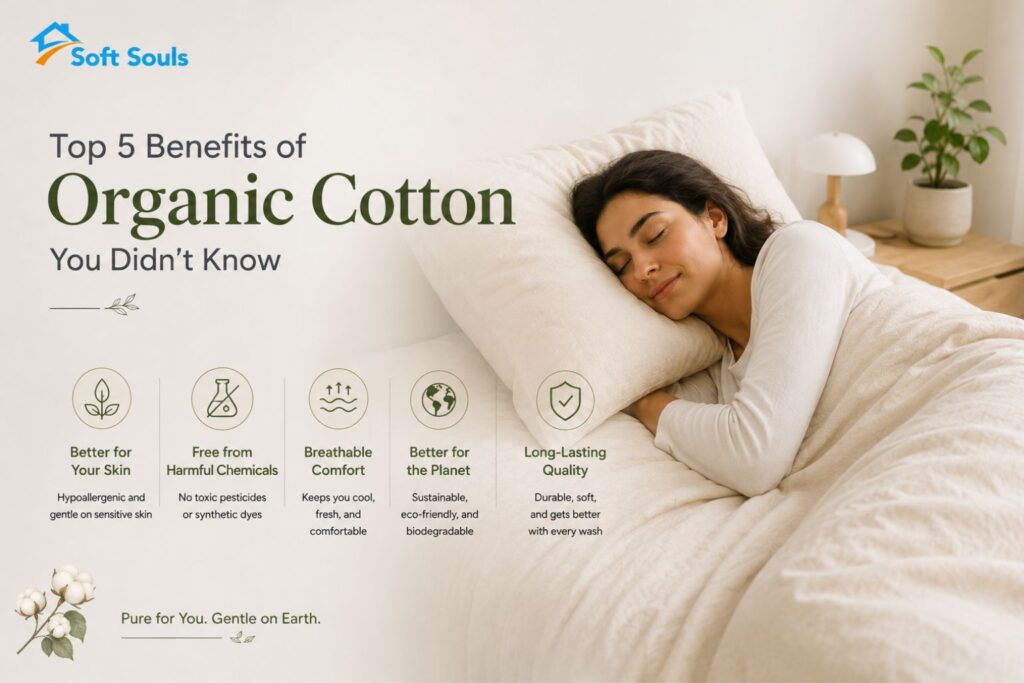
Top 5 Benefits of Organic Cotton for Daily Sleep Comfort
Benefit 1 — Better Breathability and Airflow
Each organic cotton fibre has a naturally hollow, twisted structure that allows air to pass through the weave. When this structure is preserved through chemical-free processing, the fabric breathes continuously heat escapes, fresh air circulates, and the sleeping surface stays cooler.
This is the most consistent and practical of all organic cotton advantages for Indian weather. Whether it is a Chennai summer, a humid Mumbai monsoon night, or a Hyderabad pre-monsoon week better airflow in the pillow and bedding makes a noticeable difference.
Benefit 2 — Softer Feel That Improves Over Time
Organic cotton that has not been coated with synthetic softeners retains its natural softness. And unlike synthetic finishes that wear off and leave fabric rougher over time, organic cotton tends to get softer with every wash.
For daily sleep use which means washing the pillow cover every week or two this matters. A breathable cotton pillow made from organic cotton becomes more comfortable the more it is used, not less.
Benefit 3 — Reduced Chemical Exposure During Sleep
Conventional cotton is one of the most chemically intensive crops in the world. Even after harvesting and processing, residues from pesticides, chemical dyes, formaldehyde-based finishes, and flame retardants can remain in the finished fabric.
Spending 7–8 hours with that fabric against your face and neck every night adds up. The health benefits of organic cotton here are about reduction of exposure over time, not dramatic immediate change. Cleaner fabric means fewer potential irritants against skin, night after night.
As chemical-free sleep products go, certified organic cotton is one of the most widely available and well-tested options for everyday bedding.
Benefit 4 — Better Moisture Handling for Indian Conditions
Cotton absorbs moisture from the skin and releases it through evaporation. In Indian summer conditions where sweating during sleep is common, especially without AC this moisture management capability is directly relevant to sleep comfort.
Organic cotton handles this better than synthetic alternatives because the natural fibre structure is not blocked by chemical coatings. Sweat moves away from the skin surface rather than sitting against it. The benefits of organic cotton for people who sweat during sleep are consistent and practical.
For natural cotton bedding India homes can rely on through warm months, the combination of breathability and moisture handling makes organic cotton a straightforward choice.
Benefit 5 — Suitable for Daily Use Across Seasons
One of the underappreciated organic cotton advantages is its year-round usability. During summer, the breathability and moisture management properties keep the sleeping surface cooler. During cooler months, cotton provides gentle insulation without the stuffiness of synthetic materials.
For Indian households where the climate shifts significantly across the year from the dry heat of March–May to the humidity of June–September to the relative cool of November–February a fabric that works reasonably well across all three conditions is genuinely useful.
How Does Organic Cotton Help in Indian Weather?
Indian weather is warm, often humid, and dusty none of which suits synthetic bedding particularly well.
Warmth and humidity are handled through breathability and moisture absorption. Dust sensitivity is addressed through the natural hypoallergenic properties of organic cotton, which does not attract dust mites the way synthetic materials do. Chemical sensitivity which becomes more of a problem when you are sweating, because moisture activates surface chemicals is reduced by the absence of chemical treatments in the first place.
As natural cotton bedding India households can use practically and wash regularly, organic cotton holds up well under the cleaning frequency that Indian conditions require. It does not lose its softness or structure after repeated washing the way synthetic alternatives often do.
Regular Cotton vs Organic Cotton vs Synthetic Pillow
| Feature | Organic Cotton Pillow | Regular Cotton Pillow | Synthetic Pillow |
| Breathability | Good open fibre, no chemical coating | Moderate some chemical processing reduces airflow | Poor dense synthetic fill blocks air |
| Heat Retention | Low heat escapes through natural fabric | Moderate depends on processing and fill | High traps body heat |
| Sweat Comfort | Absorbs and releases moisture naturally | Absorbs but may hold chemicals on surface | Holds moisture, becomes damp |
| Skin Feel | Soft, natural, no residues | Varies may contain chemical finishes | Can feel rough or plasticky over time |
| Chemical Exposure | Minimal grown and processed organically | Present from pesticides and finishing | Significant synthetic materials and dyes |
| Durability | Softens and improves with washing | Varies by processing quality | Can harden or lose shape with use |
| Indian Weather Suitability | Well-suited breathes and manages moisture | Moderate | Poor in hot, humid conditions |
Are Organic Cotton Pillows Good for Sensitive Skin?
Yes. An organic cotton pillow is a more considered choice for sensitive skin for a straightforward reason: fewer chemicals in contact with skin for fewer hours every night.
People who experience facial redness, morning puffiness, unexplained itching, or skin reactions that worsen during warm weather often find improvement after switching away from synthetic or conventionally processed bedding. The trigger is usually not dramatic it is the cumulative effect of consistent low-level chemical contact through prolonged skin exposure.
The health benefits of organic cotton for sensitive skin are not a cure for existing conditions. They are the result of removing a consistent, often overlooked source of daily irritation.
How to Choose a Good Organic Cotton Pillow?
1. Look for GOTS Certification
GOTS (Global Organic Textile Standard) covers both farming and processing. It is the most reliable confirmation that the fabric is genuinely organic rather than just marketed as such.
2. Check the Filling
The cover fabric matters, but so does what is inside. A breathable cotton pillow should ideally have a natural fill organic cotton fibre, kapok (Illavam Panju), or similar. A synthetic polyester fill inside an organic cotton cover reduces the breathability benefit significantly.
3. Consider the Fabric Weave
For warm Indian weather, a medium or open-weave cotton fabric breathes better than a tightly woven one. Heavier weaves can feel comfortable in cooler months but become warm and dense in summer.
4. Washability
Bedding requires regular washing in India’s dusty, humid conditions. Confirm the cover is machine washable and holds its softness after repeated washing.
5. Pillow Firmness
Choose firmness based on sleep position. Side sleepers need firmer, fuller support. Back sleepers do well with medium firmness. Stomach sleepers need a softer, flatter option. Most organic cotton pillow brands offer variants check before buying.
6. Brand Transparency
Any genuine chemical-free sleep products brand will clearly state its materials, certifications, and care instructions. Vague language around “natural” or “eco” without specific material disclosure is worth questioning.
Soft Souls — Natural Cotton Comfort for Indian Homes
For those looking for an organic cotton pillow designed with Indian conditions in mind, Soft Souls (softsouls.in) is worth exploring.
Soft Souls is an Indian sleep brand built around a clear belief: quality sleep starts with honest materials. Their cotton and Illavam Panju pillow range is handcrafted by Indian artisans using 100% pure natural Kapok fibre and breathable organic cotton fabric designed for daily sleep comfort in warm, humid Indian weather.
Their approach to natural sleep products includes:
- Cotton and Illavam Panju (Kapok) pillow collections 100% organic Kapok-filled pillows wrapped in breathable cotton fabric; lightweight, airy, hypoallergenic, and chemical-free for Indian sleepers who care about what is inside their pillow
- Kids pillow range Kapok-filled with organic cotton covers, gentle and breathable for children, suitable for warm and humid climates
- Organic cotton pillow covers and pillowcases breathable covers in organic cotton and mulberry silk for a cleaner, more comfortable sleeping surface
- Natural cotton bedding collections including satin bedsheets and organic accessories that complement the pillow range.
As natural cotton bedding India households can trust for daily use, Soft Souls focuses on practical, material-honest products supporting local artisans, using eco-friendly materials, and keeping the emphasis on sleep comfort that actually works for Indian conditions.
Conclusion
The benefits of organic cotton for everyday sleep in India are practical rather than abstract. Better airflow. Less heat retention. Softer fabric feel. Reduced chemical contact with skin. More consistent comfort across warm, humid weather.
These are not incremental improvements. They are the result of using a material that works the way it is naturally supposed to without the chemical processing that reduces its breathability, compromises its softness, and adds unnecessary residues to something you sleep on every night.
Starting with one organic cotton pillow or cover is enough to feel the difference. The improvement is not dramatic on night one. But over weeks of consistently more comfortable sleep in Indian heat, through Indian humidity it becomes the kind of choice that is hard to reverse.
FAQ
What are the benefits of organic cotton?
The benefits of organic cotton for sleep are practical and specific. It breathes better because the natural fibre structure is not blocked by chemical processing. It stays softer longer because no synthetic coating is wearing off over time. It carries fewer chemical residues in contact with your skin. And for Indian weather warm, humid, and often dusty the combination of breathability and moisture management makes it a consistently more comfortable fabric for daily sleeping use.
Is organic cotton good for sleep?
Yes. Organic cotton advantages for sleep come from what the fabric is and is not. It is naturally breathable, absorbs moisture and releases it, and stays soft with regular use. It is not coated with synthetic finishes that reduce airflow or leave chemical residues in contact with your skin through the night. For Indian conditions where heat and humidity make synthetic bedding particularly uncomfortable organic cotton is a straightforward, practical improvement for everyday sleep comfort.
Why does organic cotton feel softer?
Organic cotton feels softer because the natural texture of the fibre is preserved through chemical-free processing. Conventional cotton is often treated with softening agents during production but those agents wear off after washing, leaving the fabric rougher over time. Organic cotton that has not been chemically treated starts soft and continues to soften with every wash. The health benefits of organic cotton fabric include this improving softness, which makes the sleeping experience consistently better over months of use rather than declining.
Are organic cotton pillows suitable for Indian weather?
Yes. An organic cotton pillow suits Indian weather because it handles heat and moisture the way natural cotton is supposed to by allowing airflow and absorbing sweat rather than holding it. Synthetic alternatives trap body heat and accumulate moisture, which makes warm, humid nights more uncomfortable. The breathable cotton pillow quality of organic cotton is not engineered in it is the natural behaviour of properly processed cotton fibre in Indian conditions throughout the year.
Can organic cotton help sensitive skin?
Yes. The health benefits of organic cotton for sensitive skin come from reduced chemical exposure. Conventional bedding can carry residues from pesticides, synthetic dyes, and fabric finishing treatments that remain in prolonged contact with skin during sleep. Organic cotton avoids most of this. For people who experience morning puffiness, facial redness, or itching from bedding contact particularly in warm weather when sweating increases chemical activation switching to chemical-free sleep products often produces noticeable improvement.
How to choose an organic cotton pillow?
Look for GOTS certification first it is the most reliable organic confirmation. Check the filling: an organic cotton pillow with a natural fill like kapok or organic cotton fibre breathes better than one with a synthetic interior. Confirm the cover is machine washable. Choose firmness based on sleep position. Buy from a brand that clearly discloses its materials transparent labelling is itself a quality marker for any genuinely breathable cotton pillow worth buying.