
Introduction
The Pillow Nobody Talks About,
Indian summers have a way of turning a perfectly good night into something you just want to get through. The room is warm. The fan is on. You settle in, close your eyes and twenty minutes later the pillow feels like it has been sitting in the sun all day.
Most people reach for the other side of the pillow. Then that side warms up too. Eventually, you are just lying there, slightly too warm, occasionally shifting, wondering why sleep feels like more effort than it should.
The pillow is almost always a large part of this problem. Synthetic polyester fill does not breathe. Dense foam does not release heat. And for those sleeping in non-AC rooms across India which is most people this creates a small but persistent discomfort every single night.
Illavam Panju is the traditional answer that Indian homes had to this problem long before synthetic materials existed. A naturally hollow, plant-based fibre that has been used in South Indian pillows for generations. Lightweight, airy, and suited for tropical conditions in a way that no synthetic fill quite matches.
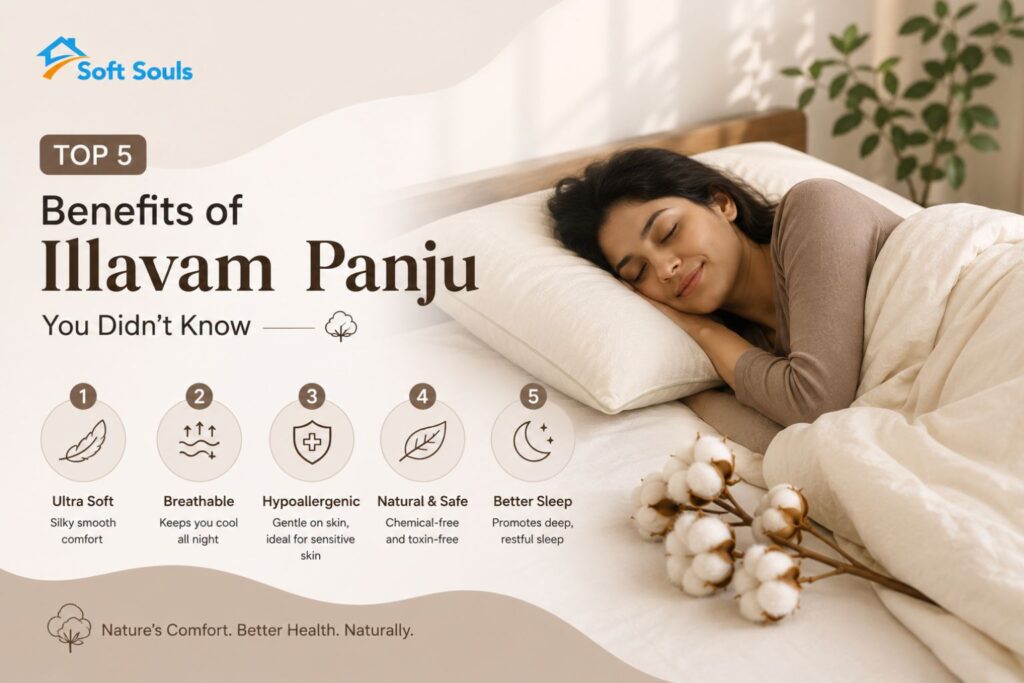
The benefits of illavam panju go beyond comfort they include breathability, moisture resistance, skin-friendliness, and a genuinely lighter sleeping feel. This guide covers all five, along with practical guidance for choosing the right illavam panju pillow.
What is Illavam Panju?
Illavam Panju is the Tamil name for Kapok a natural plant fibre harvested from the seed pods of the Ceiba tree, also known as the Ilavam tree in South India. The tree grows naturally in tropical regions, including parts of Tamil Nadu, Kerala, and Andhra Pradesh.
When the pods ripen and burst open, they release clusters of silky, cream-coloured fluff. This fluff Illavam Panju is one of the lightest natural fibres available. Each fibre is naturally hollow, which is the root cause of almost all the properties that make it so useful for sleeping comfort.
As a traditional pillow filling, Illavam Panju was a household staple in South Indian homes for decades. Pillows were stuffed with it. Thin cotton mattresses were filled with it. Families aired them out in sunlight to keep them fresh. It was practical, natural, and well-suited to the conditions of the region.
Why Do Regular Pillows Feel Hot at Night?
Ever noticed how some pillows feel warm even with the fan running? The fill material is almost always responsible.
Polyester fibre the most common synthetic fill compresses under the weight of your head. Once compressed, it becomes a dense, airless block. Body heat from your head and neck goes into the pillow and has no clear path out. Over a few hours, the surface temperature rises noticeably.
Foam behaves similarly. Its structure is solid by design good for support, poor for ventilation. Heat accumulates. Sweat builds up inside the cover because synthetic fabric does not allow moisture to evaporate easily. By midnight, the pillow feels heavy and damp.
A natural pillow for hot weather works differently because the fill structure is fundamentally different. Hollow fibres allow air to move through the pillow continuously. Heat escapes rather than accumulating. Moisture is handled rather than held.
Top 5 Benefits of Illavam Panju
Benefit 1 — Better Airflow and Breathability
The hollow structure of each Illavam Panju fibre is not incidental. It is the defining physical property that makes this a genuinely breathable pillow India sleepers can rely on through summer.
Air circulates through the filling constantly. When body heat builds up near your head, it has a natural path out through the airy fill, through the cotton cover, into the room. This means the pillow surface stays relatively cooler through the night rather than accumulating heat.
This is not a feature added through engineering. It is how the fibre works in its natural state. No cooling gel, no special weave, no synthetic treatment required.
Benefit 2 — More Comfortable for Sweating During Sleep
One of the clearest kapok pillow benefits for Indian weather is its natural moisture resistance. Illavam Panju fibre does not absorb and hold sweat the way polyester does. Moisture from the skin passes through the fill rather than sitting inside it.
As a cooling pillow for sweating at night, this makes a consistent and practical difference. The pillow surface stays drier. That damp, sticky feeling that builds up in a synthetic pillow through a warm night is significantly reduced with an Illavam Panju fill.
For people who wake up with a moist or heavy pillow this is one of the most noticeable improvements from switching to a natural fill.
Benefit 3 — Lightweight and Softer Feel
Pick up a kapok pillow and compare it to a standard polyester-filled one. The difference in weight is immediate. Illavam Panju is one of the lightest natural filling materials available much lighter than cotton fibre, polyester, or memory foam.
This matters for sleep in ways that are not always obvious. Less weight means less pressure against the head and neck. Less pressure means better circulation at the contact point. Better circulation means the skin stays cooler. The light, airy texture also has a softness that synthetic fills do not replicate well silky rather than rubbery, gentle rather than resistant.
The illavam panju pillow feel is genuinely different from anything synthetic. It is one of those things easier to understand after experiencing than to describe beforehand.
Benefit 4 — Better for Sensitive Skin
Illavam Panju is a plant-based, minimally processed natural fibre. There are no synthetic coatings, chemical treatments, or pesticide residues involved in its production when sourced carefully. Paired with an organic cotton cover, it offers a sleeping surface with very few chemical irritants in direct contact with skin.
For people who experience:
- Facial redness or puffiness in the mornings
- Itching or mild skin irritation from pillow contact
- Sensitivity to synthetic fabrics during prolonged wear
- Reactions that worsen in warm, sweaty conditions
…switching to a natural fill often produces noticeable improvement. It is not a remedy it is the result of removing common irritants from something your skin is in contact with for 7–8 hours every night.
The benefits of illavam panju for sensitive skin come from what the material does not contain as much as from what it does.
Benefit 5 — Suited to Indian Weather Across Seasons
This is perhaps the most practical of all the kapok pillow benefits: Illavam Panju was originally used in tropical conditions. It is not a material adapted for warm weather it is a material that originated there.
Hot summer nights, high humidity, non-AC rooms, monsoon season all of these are conditions where the hollow fibre structure and moisture-resistant properties of Illavam Panju work in your favour. The natural pillow for hot weather quality is not a marketing point. It is the reason this fibre was used in South Indian homes for generations before synthetic alternatives arrived.
In cooler months, Illavam Panju continues to perform well. It is not as heavy as a foam or latex pillow, but the natural fill provides enough warmth without becoming the insulator that synthetic materials do in summer.
What Makes Illavam Panju Breathable? Material Science
The science behind Illavam Panju breathability is simple. Each kapok fibre is hollow like a tiny, sealed tube. When these fibres are loosely packed inside a pillow, the space inside each fibre and the gaps between fibres create a continuous network of air channels.
Air moves through this network freely. Heat generated by the head and neck during sleep travels through those channels and dissipates. The sleeping surface does not trap thermal energy the way a dense, solid fill does.
Moisture management works through a different but related mechanism. Kapok fibre has a waxy surface coating that makes it naturally moisture-resistant. Sweat does not cling to the fibre or penetrate it the way it does in polyester or cotton fill. Instead, moisture passes through the fill or evaporates from the cover surface.
Compare this to polyester staple fill: solid, non-hollow synthetic fibres that pack together under pressure, leaving almost no internal air movement. Or memory foam: a continuous solid block with built-in compression that is specifically designed to resist air movement.
The physics of natural hollow fibre versus synthetic solid fill explains everything about why an illavam panju pillow feels the way it does and why that difference matters most in warm, humid Indian conditions.
Regular Synthetic Pillow vs Illavam Panju Pillow
| Feature | Illavam Panju / Kapok Pillow | Regular Synthetic Pillow |
| Heat Retention | Low heat escapes through hollow fibre structure | High traps body heat near head and neck |
| Breathability | Excellent continuous airflow through natural fill | Poor dense synthetic fill blocks air movement |
| Sweat Comfort | Moisture-resistant fibre stays noticeably drier | Holds moisture, becomes damp and heavy overnight |
| Pillow Feel | Silky, soft, lightweight and airy | Springy or firm, heavier, denser against the skin |
| Air Circulation | Natural and consistent through hollow fibres | Very limited through compressed fill |
| Weight | Very lightweight noticeably lighter to handle | Heavier, especially foam and dense polyester types |
| Daily Comfort | Well-suited to warm and humid Indian conditions | Comfortable in cool weather, uncomfortable in heat |
Who Should Use an Illavam Panju Pillow?
People who sweat during sleep. If a damp, warm pillow is a regular experience, the fill material is the issue. A cooling pillow for sweating at night made from kapok handles moisture differently and delivers consistent improvement.
Homes without AC. When room temperature is already warm, the pillow material becomes more significant. An illavam panju pillow stays cooler longer than any synthetic alternative in a non-AC environment.
Sensitive skin users. Fewer chemicals, a natural plant-based fill, and gentle organic cotton covers make Illavam Panju a cleaner sleeping option for skin that reacts to synthetic materials.
Side sleepers looking for a softer feel. The natural give of kapok fill adapts gently to the shape of the head and neck without the rigid resistance of foam. For side sleepers who want soft support without pressure points, it is a practical fit.
People who want traditional natural comfort. As a traditional pillow filling that has been used in Indian homes for generations, Illavam Panju connects to a sleep practice that predates synthetic materials and performs well enough to justify returning to it.
How to Choose an Illavam Panju Pillow in India?
1. Confirm 100% Natural Kapok Fill
Some products blend kapok with polyester to reduce cost. Even a partial synthetic fill reduces breathability. Look for clear labelling: “100% kapok” or “100% Illavam Panju filling.”
2. Check the Cover Fabric
The outer cover should be breathable organic cotton. A synthetic polyester cover cancels much of the breathability benefit from the natural fill inside. Medium-weave cotton fabric works well across Indian seasons.
3. Pillow Firmness and Fill Amount
Kapok fill tends toward softer, loftier comfort. For side sleepers needing more neck support, look for a fuller fill or a brand that offers adjustable fill. Back and stomach sleepers typically find standard kapok loft comfortable.
4. Suitable Pillow Size
Standard sizes (18×28 inch and similar) work for most adults. For children, smaller sizes with lighter fill are available and provide appropriate support without excess weight.
5. Washability
The cover should be removable and machine washable. Kapok filling does not require machine washing — periodic sun-airing refreshes the fibre and restores its natural properties. Check care instructions before buying.
6. Brand Transparency
A trustworthy seller will clearly state what the fill is, how the cover is made, and how to care for the product. Vague claims like “natural feel” or “cooling effect” without material disclosure are worth questioning. Clear disclosure of kapok filling and cotton cover material is the standard to expect from any reliable breathable pillow India product.
Soft Souls — Natural Kapok Comfort for Indian Homes
For those looking for a genuine illavam panju pillow made with Indian conditions in mind, Soft Souls (softsouls.in) is a brand worth knowing.
Soft Souls handcrafts each pillow using 100% pure natural Kapok fibre wrapped in breathable organic cotton fabric, created by Indian artisans who blend traditional craftsmanship with practical everyday comfort. Their pillows are designed for people who care about what is inside their pillow as much as how it feels.
Their Illavam Panju pillow range includes:
- Standard and queen-size kapok pillows filled with 100% pure, natural Kapok fibre, lightweight, airy, and resistant to clumping for long-lasting comfort, naturally dust-mite resistant, hypoallergenic, and chemical-free.
- Kids pillow range filled with premium Kapok (Illavam Panju), with an organic cotton cover that feels smooth and gentle against skin, allowing continuous airflow to help reduce heat and moisture build-up during sleep, comfortable in all seasons especially in warm or humid climates.
- Satin bedsheets and pillow covers for a complete, naturally comfortable sleep setup suited to Indian bedrooms
- Organic cotton pillow collections for those who prefer cotton fill with breathable cotton covers
Soft Souls is designed for those who care about what is inside their pillow as much as how it feels supporting local Indian artisans and offering eco-friendly sleep products that connect modern comfort with traditional natural materials.
For Indian families looking for a natural pillow for hot weather that is honest about its materials, made by Indian hands, and designed for Indian conditions, Soft Souls is a practical and transparent starting point.
Conclusion
The benefits of illavam panju are not complicated or overstated. Better airflow. Less heat retention. Natural moisture resistance. Lighter weight. Fewer synthetic irritants against your skin. Suited to the warm, humid conditions that Indian weather brings for much of the year.
None of these are small things when you consider that a pillow is in contact with your face and neck for 7–8 hours every night. And none of them require any special engineering they come from the natural structure of a plant fibre that Indian homes understood and trusted long before synthetic alternatives existed.
Switching to an illavam panju pillow is not a dramatic change. But on the first warm night where the pillow stays comfortable through to morning it is a difference that is hard to argue with.
FAQ
What is Illavam Panju?
Illavam Panju is the Tamil name for Kapok a natural, hollow plant fibre harvested from the seed pods of the Ceiba (Ilavam) tree. It is one of the lightest natural fibres available and has been used as a traditional pillow filling in South Indian homes for generations. The hollow fibre structure allows constant airflow, which is why it stays cooler than synthetic alternatives. It is plant-based, chemical-free, and naturally suited to tropical sleeping conditions.
What are the benefits of Illavam Panju?
The benefits of illavam panju for sleep are practical and specific. The hollow fibre allows constant airflow, keeping the pillow surface cooler. It naturally resists moisture, so sweat does not accumulate inside the fill. It is significantly lighter than polyester or foam alternatives, reducing pressure on the head and neck. It is plant-based with no chemical residues, which is gentler for sensitive skin. And it is genuinely suited to warm, humid Indian weather in a way synthetic fills are not.
Are Kapok pillows good for Indian weather?
Yes. Kapok pillow benefits are specifically well-suited to Indian weather. The hollow fibre allows continuous airflow, preventing heat from building up near the head. Its natural moisture resistance keeps the sleeping surface drier on humid nights. For non-AC homes especially, the difference from a dense synthetic fill is noticeable from the first warm night. As a breathable pillow India option for daily use, kapok consistently outperforms polyester and foam in hot, humid conditions that most of India experiences for a significant part of the year.
Why do synthetic pillows feel hotter?
Synthetic pillows trap heat because the fill material polyester or foam is dense and solid. Air does not move through compressed polyester fibres the way it does through hollow natural fibres. Body heat builds up inside the pillow with nowhere to go. Sweat does not evaporate through synthetic fabric. Over a few hours, the result is a warm, damp surface that becomes progressively more uncomfortable. A natural pillow for hot weather solves this by allowing heat to escape through the fill rather than holding it in.
How to choose an Illavam Panju pillow?
Confirm the fill is 100% natural kapok not blended with polyester. Check that the cover is breathable organic cotton rather than a synthetic fabric. Confirm the cover is machine washable for regular cleaning. Choose fill firmness based on sleep position: side sleepers need a fuller fill for neck support, back and stomach sleepers do well with standard kapok loft. Buy from a brand that clearly discloses its materials. A genuine illavam panju pillow will be transparent about what is inside that transparency is itself a quality marker.