Introduction
Two Natural Materials, One Familiar Problem
Sleep in India during summer is its own challenge. The fan is running. The room is tolerable. And yet, by midnight, the pillow feels warm, the neck is sticky, and rest keeps sliding away. Most people blame the weather. A more accurate target is the pillow material.
Synthetic pillows trap heat. That much is well understood. But as more Indian sleepers start exploring natural alternatives, a new question comes up should the shift be toward kapok or bamboo?
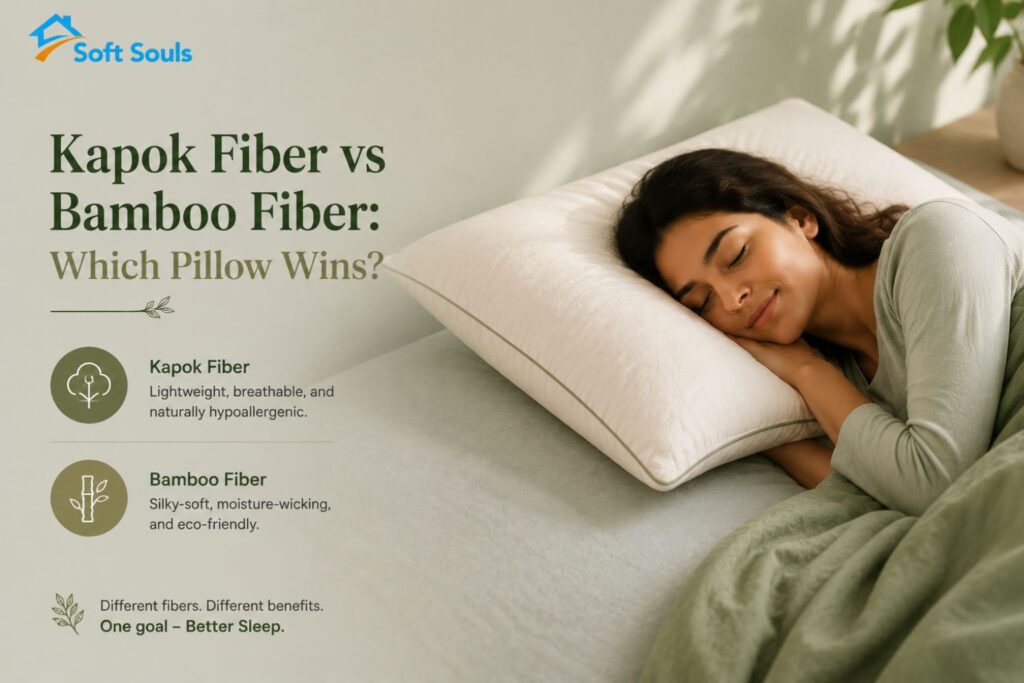
Both are marketed as breathable, natural, and eco-friendly. Both are genuine improvements over polyester fill. But they come from different sources, behave differently in warm humid conditions, and suit different sleepers in different ways. The kapok fiber vs bamboo fiber pillow comparison is worth examining carefully before buying.
This article breaks down both materials across every dimension that matters for Indian sleep comfort softness, breathability, heat management, sustainability, support, and practical daily use.
What Is Kapok Fiber?
Kapok is a natural plant-based fibre harvested from the seed pods of the Ceiba pentandra tree called the Ilavam tree in South India, which gives the fibre its Tamil name, Illavam Panju. When the pods ripen and burst, they release clusters of silky, lightweight fluff. This fluff is collected and used as a pillow and mattress filling.
The defining physical characteristic of kapok is that each fibre is hollow. Not just fine or lightweight actually hollow, with a natural air-filled interior. This hollow structure is what drives kapok’s breathability, moisture resistance, and lightweight feel as a pillow filling.
Kapok requires minimal processing. The fibre is harvested naturally, without cutting down trees, and used in a near-natural state. It has been a natural pillow for hot sleepers across South Indian homes for generations not a modern innovation, but a traditional material being rediscovered for its practical properties.
What Is Bamboo Fiber?
Bamboo fiber used in bedding does not come directly from the bamboo plant the way kapok fibre comes from a pod. Bamboo is a raw material the plant’s pulp is processed using chemical or mechanical methods to extract fibres that can be spun into fabric.
The most common process, viscose or rayon manufacturing, dissolves bamboo pulp in chemicals to produce cellulose fibres. These are then spun into yarn or fabric. The resulting material commonly labelled “bamboo” fabric is soft, moderately breathable, and has moisture-wicking properties.
Bamboo fiber is used in pillow covers and pillowcases more often than as a fill material. When the pillow cover is bamboo-derived fabric, the fill is typically latex, memory foam, or polyester. So when comparing a bamboo fiber pillow, the comparison often covers the cover fabric rather than the fill.
Bamboo has become popular in modern sleep products for its silky texture, reputation for being eco-friendly, and moisture-wicking marketing appeal. The reality is somewhat more complex particularly around processing.
Kapok Fiber vs Bamboo Fiber Pillow: Quick Comparison
| Feature | Kapok Pillow | Bamboo Fiber Pillow |
| Softness | Silky, light, airy feel | Smooth, soft often silky cover fabric |
| Breathability | Excellent hollow fibre allows airflow | Moderate depends heavily on fill material |
| Temperature Regulation | Low heat retention heat escapes through hollow fill | Variable cover breathes but fill may trap heat |
| Moisture Management | Naturally moisture-resistant fibre repels moisture | Moisture-wicking cover fabric fill varies |
| Sustainability | Plant-harvested, minimal processing, biodegradable | Fast-growing source, but chemical processing involved |
| Support | Soft, gentle, adjustable in some products | Depends on fill can range from soft to firm |
| Durability | 3–5 years with care | Varies widely by fill type |
| Maintenance | Sun-air fill; machine wash cover | Machine washable cover; fill care varies |
| Eco-Friendliness | High low footprint across lifecycle | Moderate bamboo plant is eco-friendly, processing less so |
| Suitability for Indian Weather | Excellent designed for tropical conditions | Moderate cover helps, fill is the variable |
Which Material Feels Softer?
Softness in a pillow comes from two sources: the fill and the cover. For kapok fiber vs bamboo fiber pillow comparisons, both apply differently.
Kapok fill has a silky, airy softness lightweight and gently yielding. It does not have the dense plushness of high-quality down, but it has a delicate, smooth surface quality that is easy on skin during prolonged contact. The fill compresses gently and redistributes with movement.
Bamboo cover fabric, when well-made, has a noticeably silky smoothness against the skin. This is the quality that earns bamboo its reputation for softness the cover fabric feels like a smoother, more refined surface than standard cotton weave. However, the softness of the pillow as a whole depends on the fill, which in most bamboo-marketed pillows is not bamboo at all.
Long-term comfort also differs. Kapok fill maintains its soft, airy texture with regular fluffing. Bamboo cover fabric holds its smoothness with washing. But if the fill inside a bamboo-cover pillow is synthetic, it compresses over time in the usual way synthetic fill does and the softness of the cover becomes less relevant to overall sleep comfort.
For sleepers who prioritise the feel of the fill material over the surface texture, kapok is the more directly relevant natural option. For those who care most about the tactile feel of fabric against skin, a bamboo pillowcase or cover can add that quality to any pillow.
Which Pillow Sleeps Cooler?
This is the most important question for Indian hot sleepers and the answer depends on what is actually inside the pillow.
Kapok fill is genuinely breathable at the fill level. The hollow fibre creates continuous air channels inside the pillow. Heat generated by the head and neck moves through these channels and escapes rather than accumulating. The naturally moisture-resistant fibre surface prevents sweat from building up inside the fill.
Bamboo cover fabric has moderate breathability and moisture-wicking properties. It moves moisture away from the skin surface reasonably well. But if the fill inside is polyester or memory foam, the breathability of the cover fabric has a limited effect on how warm the pillow becomes. The cover helps at the surface; the fill determines the deeper heat management.
As a breathable pillow India option for warm and humid conditions:
- A kapok-fill pillow with a cotton cover performs consistently in heat and humidity
- A bamboo-cover pillow with a natural fill can also perform well but the fill type is the critical variable
- A bamboo-cover pillow with a synthetic fill primarily benefits from surface softness, not genuine heat management
For hot sleepers who sweat at night and sleep in non-AC Indian rooms, kapok fill directly addresses the heat problem at the source. As a natural pillow for hot sleepers, the hollow fibre ventilation of kapok is more reliably effective than a breathable cover alone.
Sustainability Comparison: Which Is More Eco-Friendly?
Kapok
Kapok is harvested from naturally falling pods of the Ceiba tree. No trees are cut down. No farming chemicals are required. The fibre needs minimal processing to be functional as a fill. At the end of its lifespan, it biodegrades naturally. It is one of the more genuinely low-impact natural fibres available as an eco friendly pillow filling.
Bamboo
Bamboo as a plant is genuinely sustainable it grows fast, requires no pesticides, and regenerates without replanting. But the fibre used in bedding is not bamboo in its raw form. The pulp is dissolved in chemical solutions (typically sodium hydroxide and carbon disulfide in viscose processing) to extract usable fibre. This process generates industrial effluents and uses non-renewable chemicals.
Mechanical processing of bamboo (producing “bamboo linen”) is much cleaner but produces a rougher, less uniform fibre used less commonly in bedding products.
Net result: Bamboo as a raw material is environmentally responsible. The common processing method used to turn it into soft fabric carries a meaningful chemical footprint. Kapok’s path from pod to pillow is shorter, simpler, and cleaner.
For an eco friendly pillow choice based on full lifecycle impact, kapok carries a clearer environmental credential than most commercially available bamboo-viscose products.
Which Pillow Offers Better Support?
Neither kapok nor bamboo fill (in its traditional forms) provides firm, structured support. Both are on the softer end of the pillow spectrum.
Kapok provides a gently resilient soft support. It does not collapse entirely under the head the hollow fibre offers light pushback but it is not a firm support option. Some kapok pillows allow fill adjustment, which makes it possible to increase loft for side sleepers needing more neck elevation.
Bamboo-cover pillows with natural latex fill can provide meaningful support, since latex is firmer and more resilient than kapok. If the bamboo-marketed pillow contains a memory foam or latex fill, the support characteristics are determined entirely by that fill.
For sleep position guidance:
- Side sleepers Need sufficient loft; adjustable kapok fill or a natural latex option with bamboo cover are both reasonable
- Back sleepers Medium loft works; standard kapok fill is typically comfortable
- Combination sleepers Kapok’s easy redistribution with movement suits frequent position changes
- Heavy support needs Neither kapok nor bamboo cover alone is sufficient; consider fill type separately
Benefits of Choosing a Kapok Pillow
The kapok pillow benefits for Indian sleepers are specific and consistent:
- Lightweight feel Noticeably lighter than polyester, foam, or most other natural fills
- Better airflow Hollow fibre creates natural internal ventilation that keeps the pillow surface cooler
- Natural fibre filling Plant-based, minimal processing, no synthetic residues
- Reduced heat build-up Heat escapes through the fill rather than accumulating at the neck
- Comfortable loft Soft, airy support that maintains structure with regular fluffing
- Suitable for Indian climates Designed for tropical conditions; performs in heat and humidity
- Sustainable sourcing Renewable, biodegradable, low-impact from harvest to end of life
- Moisture resistant Sweat does not accumulate in the fill; the surface stays drier through warm nights
As an organic sleep pillow filling, kapok delivers these properties naturally without cooling gels, chemical treatments, or engineered breathability.
When Might a Bamboo Pillow Be a Good Choice?
Bamboo fiber options genuinely suit certain sleepers and preferences:
Soft fabric feel against skin. If the tactile experience of the pillowcase against the face is a priority, a bamboo-viscose cover or pillowcase delivers a noticeably silky surface that cotton does not replicate.
Moisture-wicking at the surface. Bamboo fabric does wick moisture from the skin reasonably well. For sleepers who sweat lightly and want a cover that manages surface moisture, bamboo fabric performs adequately.
Preference for bamboo aesthetics. Some buyers prefer bamboo for its natural associations and modern eco-friendly positioning, and a well-sourced bamboo product can provide a comfortable experience.
Pairing with natural fills. A bamboo cover pillow with a natural latex or kapok fill combines the surface softness of bamboo fabric with the breathable fill properties of a natural material a reasonable combination.
The honest caveat is that many bamboo pillows sold in India pair bamboo covers with synthetic fills. In those cases, the breathability and thermal benefits of the bamboo fabric are partially offset by the heat-retaining fill inside.
Which Pillow Is Better for Indian Sleepers?
| Sleeper Profile | Recommendation |
| Hot sleepers | Kapok hollow fibre ventilation addresses heat at fill level |
| Homes without AC | Kapok consistent breathability in ambient Indian temperatures |
| Coastal cities (Mumbai, Chennai, Kochi) | Kapok moisture resistance handles high humidity better |
| Heavy sweaters | Kapok natural moisture resistance keeps fill dry overnight |
| Eco-conscious buyers | Kapok cleaner lifecycle than processed bamboo viscose |
| Daily comfort seekers | Both viable kapok for fill-level breathability, bamboo cover for surface softness |
How to Choose Between Kapok and Bamboo Pillows
Sleeping position Side sleepers need loft. Check if the kapok pillow allows fill adjustment. Bamboo-cover options with adjustable fill also exist.
Climate For non-AC Indian rooms in warm months, kapok fill’s internal ventilation is the more reliable heat management. For well-cooled environments, bamboo cover fabric’s surface softness becomes more relevant.
Support preference If firm support is needed, neither kapok nor a basic bamboo-cover pillow may be sufficient. Consider fill type in bamboo products.
Sustainability goals For full lifecycle eco-friendliness, kapok is the cleaner choice. For bamboo, look for mechanical-process bamboo linen rather than viscose if sustainability is the priority.
Maintenance Kapok fill needs sun-airing; bamboo fabric covers are machine washable. Both are manageable in Indian conditions.
Budget Both natural options are more expensive than standard polyester. Within natural materials, kapok pillows tend to be accessible without premium pricing.
Why More Sleepers Are Exploring Kapok Pillows
The shift toward natural bedding materials in India is driven by practical experience as much as environmental awareness. People are making the connection between material choice and sleep quality noticing that a pillow that breathes genuinely changes how a warm night feels.
Kapok in particular is gaining renewed attention because it is not an imported innovation it is a traditional Indian material. Families across South India used Illavam Panju for generations. The current interest is really a rediscovery of what worked before synthetic alternatives displaced it.
As awareness of indoor chemical exposure, fast fashion waste, and the limitations of synthetic sleep products grows, kapok’s natural credentials, tropical-condition performance, and minimal processing make it an increasingly sensible choice for Indian buyers.
Soft Souls Brand Spotlight
For those looking for a genuine kapok pillow built for Indian conditions, Soft Souls (softsouls.in) is worth knowing.
Soft Souls handcrafts pillows using 100% pure natural Kapok (Illavam Panju) fibre wrapped in breathable organic cotton fabric. Made by Indian artisans, their pillows are designed for everyday Indian sleep comfort the heat, the humidity, and the need for a breathable pillow India households can rely on year-round.
Their range includes:
- 100% Kapok pillow collections pure Illavam Panju fill, airy, lightweight, naturally hypoallergenic, and chemical-free; designed for everyday Indian use
- Kids kapok pillow range lighter fill in organic cotton covers, suitable for children in warm climates
- Organic cotton and satin pillow covers breathable covers that complement natural fills
- GOTS-certified organic cotton bedsheets plant-dyed, chemical-free, extending the natural sleep environment beyond the pillow
As an organic sleep pillow brand rooted in traditional Indian sleep materials and committed to transparent, sustainable sourcing, Soft Souls connects everyday comfort with genuine material honesty. For the kapok fiber vs bamboo fiber pillow decision specifically, their kapok range allows buyers to experience the fill-level breathability that makes kapok genuinely different from bamboo-cover synthetic alternatives.
Conclusion
The kapok fiber vs bamboo fiber pillow comparison does not produce a single universal winner it produces a clear answer for most Indian sleepers.
Bamboo fiber as a cover fabric offers real advantages: silky surface texture, moderate moisture-wicking, and a genuinely sustainable plant source. For people who prioritise surface feel and sleep in well-controlled environments, bamboo-cover pillows with quality natural fills are a reasonable choice.
Kapok as a fill material addresses the deeper problem of heat and moisture management at the fill level where it matters most for hot sleepers. The hollow fibre breathes continuously, resists moisture naturally, stays lightweight, and performs consistently in warm and humid Indian conditions without any chemical assistance.
For Indian sleepers dealing with night sweating, non-AC bedrooms, high humidity, and the particular discomfort of a pillow that gets warm overnight kapok fill is the more directly effective natural choice. Combined with a breathable cotton or bamboo cover, it delivers both surface softness and genuine internal ventilation.
Choose bamboo if the surface feel is the priority. Choose kapok if the heat and moisture problem at the fill level is what you are trying to solve.
FAQ
What is the difference between kapok fiber and bamboo fiber pillows?
Kapok is a natural plant-based fill material hollow fibres harvested from seed pods, used inside the pillow. Bamboo fiber is typically processed into fabric used for pillow covers, not fill. The core difference in the kapok fiber vs bamboo fiber pillow comparison is that kapok addresses heat and moisture at the fill level through hollow fibre ventilation, while bamboo fabric primarily affects the surface texture and light moisture-wicking of the cover.
Which pillow is cooler for hot sleepers?
Kapok is generally cooler for natural pillow for hot sleepers conditions. The hollow fibre creates continuous airflow inside the pillow, allowing heat to escape rather than accumulate. Bamboo cover fabric wicks moisture from the skin surface, but if the fill inside is synthetic, the pillow still retains heat internally. For hot sleepers in Indian conditions without strong AC, kapok fill provides more reliable heat management where it matters most inside the pillow.
Are kapok pillows suitable for Indian weather?
Yes. Kapok was traditionally used in South Indian homes specifically for its performance in tropical conditions. The hollow fibre allows heat to escape and resists moisture accumulation addressing the two main discomforts of Indian summer sleep. As a breathable pillow India option for warm, humid conditions including non-AC bedrooms, coastal cities, and heavy sweaters, kapok performs consistently better than synthetic alternatives and comparably or better than most bamboo-cover options with synthetic fill.
Is bamboo fiber eco-friendly?
Bamboo as a plant is genuinely sustainable fast-growing, pesticide-free, and naturally regenerating. However, most bamboo fabric used in bedding goes through a chemical viscose process that is less environmentally clean. As an eco friendly pillow source, bamboo’s environmental credentials depend significantly on the processing method. Mechanically processed bamboo linen is cleaner but less common. Kapok’s path from seed pod to pillow fill involves minimal processing and has a cleaner lifecycle overall.
Which pillow lasts longer?
Kapok pillows, when maintained with regular fluffing and periodic sun-airing, typically last 3–5 years before the hollow fibre structure begins to break down. Bamboo-cover pillows vary by fill type a bamboo cover over a latex fill can last longer than bamboo over polyester, which compresses within 12–18 months. For everyday Indian use, kapok fill generally outlasts standard polyester fill, provided the cover is washed regularly and the fill is aired occasionally.
Are kapok pillows good for neck support?
Kapok offers soft, gently resilient support rather than firm structured support. For back and stomach sleepers, standard kapok loft works comfortably. For side sleepers needing more neck elevation, an adjustable-fill kapok pillow allows the loft to be increased. The kapok pillow benefits for neck comfort come from the lack of pressure at the contact point lightweight fill means less compression and better circulation rather than from firm cervical support.
Can kapok pillows help reduce night sweating?
Yes. Kapok helps with night sweating in two ways: the hollow fibre allows heat to escape from the pillow surface, reducing the thermal trigger for sweating; and the natural moisture-resistant fibre surface prevents sweat from accumulating inside the fill. As a result, the pillow stays drier and cooler than a synthetic alternative. For people who regularly wake with a damp or warm pillow, switching to kapok typically produces noticeable improvement from the first warm night.