Introduction
The Night You Cannot Sleep Through
There is a specific kind of miserable that Indian summers produce around 2 AM. The ceiling fan is running at full speed. The room temperature is tolerable. Everything should be fine. And yet, the back of your neck is warm, the pillow has been flipped twice already, and the idea of actually falling asleep and staying asleep feels further away with each passing minute.
Night sweating in India is common, persistent, and under-discussed. Most conversations about solving it focus on room cooling fans, AC units, open windows. Almost nobody talks about the pillow, which is the material closest to the face and neck for the entire night. The temperature and moisture behaviour of that material have a direct effect on sleep comfort in ways that room cooling alone cannot address.
This is the heart of the kapok vs polyester pillows comparison. Both are used daily across Indian bedrooms. Both look similar in a shop. But they are made from fundamentally different materials that behave in fundamentally different ways when exposed to heat, humidity, and the body’s natural sleep processes.
This guide examines every relevant dimension breathability, airflow, moisture control, loft, support, durability, maintenance, and sustainability to help hot sleepers in India make a genuinely informed choice.
Why Pillow Material Matters for Hot Sleepers
Before comparing materials, it is worth understanding why the pillow matters as much as it does for people who sleep warm.
Heat retention is the primary issue. During sleep, the body naturally generates heat. A significant amount of that heat is released through the head and neck. If the pillow absorbs that heat and holds it close, the sleeping surface temperature rises through the night. By the early hours of the morning, the pillow has become noticeably warm and the body, unable to release heat effectively through the head, responds by generating sweat.
Moisture build-up compounds the problem. Once sweating begins at the neck and face, the pillow cover and fill absorb that moisture. In synthetic fill, moisture does not evaporate readily. It sits in the fill, making the pillow heavier and damper as the night progresses.
Poor air circulation is the underlying cause of both. A pillow fill with no internal air movement cannot release heat or moisture through ventilation. It absorbs both and holds both creating the warm, damp surface that disrupts sleep.
Sleep interruption is the result. Most hot sleepers do not associate their restless nights with pillow material. They assume it is the weather. But switching to a genuinely breathable pillow for summer often produces immediate and noticeable improvement because the root cause was the pillow, not the room.
Understanding Kapok Pillows
What Is Kapok?
Kapok is a natural plant-based fibre harvested from the seed pods of the Ceiba pentandra tree known in South India as the Ilavam tree, giving the fibre its Tamil name, Illavam Panju. When the pods ripen, they split open to reveal clusters of silky, cream-coloured fluff. This fluff is collected, cleaned, and used as a pillow fill.
The defining physical characteristic of kapok is that each individual fibre is hollow. Not just fine or lightweight actually hollow, with a sealed interior space. This hollow structure is the physical reason for almost every functional advantage kapok offers as a pillow filling.
As an organic sleep pillow filling, kapok is plant-based, biodegradable, harvested without cutting trees, and requires minimal chemical processing. It has been used in South Indian homes for generations a traditional sleep material with properties that align naturally with tropical conditions.
Key Features of Kapok Pillows
Breathability. The hollow fibre creates continuous natural ventilation inside the pillow. Air circulates through the fill, carrying heat away from the contact surface rather than allowing it to accumulate. This is the primary reason a kapok pillow for hot sleepers performs so differently from a synthetic alternative in Indian conditions.
Softness. The texture of kapok fibre is silky and light not the dense, springy softness of polyester, but a more airy, gently yielding feel that is easy against skin during extended contact.
Loft. Kapok fill is less structurally dense than polyester, giving it a naturally lofted feel that does not compress into a flat block. Regular fluffing maintains this loft easily.
Natural origin. No petroleum-derived materials, no synthetic coatings, no chemical residues in the finished fill.
Understanding Polyester Pillows
What Is Polyester Filling?
Polyester fill most commonly polyester staple fibre or microfibre is derived from petroleum through a chemical process that creates solid synthetic strands. These strands are cut, crimped, and packed into pillow shells to create the familiar springy feel of standard synthetic pillows.
Why Polyester Pillows Are Popular
Polyester pillows are popular for straightforward reasons: they are inexpensive to produce, widely available, machine washable, and initially comfortable. They hold their shape reasonably well when new and are soft to the touch.
Common Advantages
- Affordable price point
- Widely available across India
- Machine washable
- Consistent initial softness
- Hypoallergenic options available (microfibre)
Common Limitations
- Dense fill traps heat effectively a liability for hot sleepers
- No internal air circulation through solid synthetic fibres
- Absorbs and holds moisture rather than releasing it
- Compresses and flattens within 12–18 months of regular use
- Derived from non-renewable petroleum
- Non-biodegradable at end of life
- Can contain VOCs, synthetic dyes, and flame retardant treatments
The limitations of polyester are most apparent in warm, humid Indian conditions which are exactly the conditions most Indian sleepers face.
Kapok vs Polyester Pillows: Side-by-Side Comparison
| Feature | Kapok Pillow | Polyester Pillow |
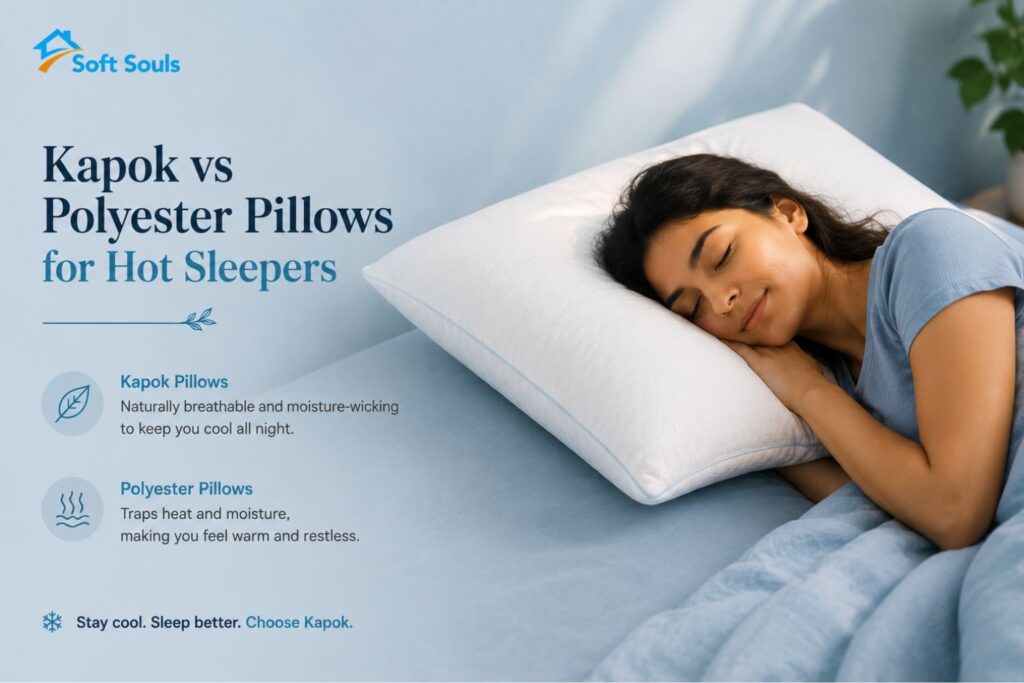
| Breathability | Excellent hollow fibre creates continuous airflow | Poor solid fibres block internal air movement |
| Temperature Regulation | Low heat retention heat escapes through hollow fill | High heat retention body heat absorbed and held |
| Airflow | Natural and consistent through the fill network | Virtually none compressed fibres seal off ventilation |
| Moisture Control | Naturally moisture-resistant, surface stays drier | Absorbs and holds moisture, becomes damp overnight |
| Comfort | Silky, light, airy gentle on skin | Springy softness initially, rough with repeated washing |
| Loft | Moderate, airy loft easy to maintain with fluffing | Higher initial loft, compresses and flattens within 1–2 years |
| Durability | Durable with care hollow fibre resilient to humidity | Compresses and loses shape relatively quickly |
| Sustainability | Plant-based, renewable, biodegradable | Petroleum-derived, non-renewable, non-biodegradable |
| Maintenance | Sun-air fill periodically; machine wash cover | Machine washable, but loses loft and shape over time |
| Price | Moderate accessible natural product | Low to moderate — widely available at low cost |
Which Pillow Stays Cooler During Hot Nights?
This is the question that matters most for hot sleepers and the answer is clear, with a physical explanation.
Heat retention in polyester pillows is a structural inevitability. Solid synthetic fibres compress together under the weight of the head. Once compressed, there is no meaningful air movement inside. Heat generated by the head is absorbed by the fill. Over a few hours, the fill temperature rises noticeably. The pillow becomes a warm, passive surface that reflects body heat back at the sleeper.
A pillow that stays cool needs internal ventilation not just a breathable cover, but genuine airflow through the fill itself. Kapok’s hollow fibre provides exactly this. Air moves through the fill continuously, carrying warm air away from the surface. Even when the room temperature is warm, the pillow surface stays relatively cooler because heat is not accumulating it is circulating.
Moisture and humid weather performance follow the same pattern. In Indian monsoon conditions, ambient humidity adds to the moisture load on the pillow. Polyester fill absorbs ambient moisture and the moisture from sweating, becoming heavier and damper. Kapok’s waxy, moisture-resistant fibre surface repels rather than absorbs moisture the fill stays drier regardless of ambient humidity.
Practical example: On a humid July night in Chennai or Mumbai, a polyester pillow that started the night at room temperature will, within two hours, be noticeably warm and faintly damp from absorbed moisture. A kapok pillow in the same conditions will maintain better surface temperature and feel drier because the hollow fibre is actively releasing heat and refusing moisture rather than holding both.
As a cooling pillow India option for all seasons, kapok’s performance advantage over polyester in warm conditions is not marginal. It is structural.
Why Hot Sleepers Often Prefer Kapok
The reasons hot sleepers prefer kapok come down to a combination of physical properties that work together in Indian weather:
- Better airflow Continuous ventilation through hollow fibre prevents heat accumulation at the skin-pillow contact point
- Lighter weight Less mass against the head and neck means less localised heat from sustained pressure
- Naturally moisture-resistant Sweat and ambient humidity do not build up inside the fill; the surface stays drier through the night
- No heat-trapping fill structure Unlike polyester’s compressed solid strands, kapok’s airy hollow network does not seal in warmth
- Comfortable sleep environment across Indian seasons From dry April heat to humid August nights, kapok handles the full range of Indian thermal conditions better than synthetic alternatives
- A genuine pillow for sweating at night The moisture resistance and ventilation properties address both causes of sweat discomfort, not just one
- Chemical-free No synthetic residues that can irritate skin when activated by sweat during warm nights
When Polyester Might Still Be a Suitable Choice
Fairness requires acknowledging where polyester does have a place.
Budget limitations. Polyester fill pillows are widely available at low price points. For households needing to furnish multiple sleeping spaces economically, polyester remains a practical short-term option.
Guest room usage. For occasional use rather than daily sleep, the heat retention and durability limitations of polyester matter less. Guest pillows do not receive daily wear and are less likely to be used in peak summer conditions night after night.
Short-term use. If a pillow is needed temporarily travel, temporary living situations a low-cost polyester option is sufficient.
Cool climates or strong AC. In environments with sustained, strong air conditioning offices, well-controlled hotel rooms the heat retention disadvantage of polyester is partially mitigated. For Indian homes with reliable, powerful AC maintained at low temperatures, the performance gap between polyester and kapok narrows.
For daily Indian sleep use in warm and humid conditions, however, polyester’s limitations are significant enough that the polyester pillow vs kapok comparison is not particularly close on the most relevant criteria.
Kapok vs Polyester for Different Sleepers
Side Sleepers
Side sleepers need sufficient loft to maintain neutral cervical alignment. Both kapok and polyester can provide this, but kapok’s adjustable fill option (available in some products) allows customisation that standard polyester does not. For warm side sleepers, kapok’s breathability advantage reduces the heat build-up at the neck that side sleeping particularly creates.
Back Sleepers
Back sleepers generally need medium loft and moderate firmness. Standard kapok loft works well for back sleepers, and the breathability benefit is equally relevant since back sleeping places the entire back of the head in sustained contact with the pillow. Polyester works structurally for back sleepers but creates the same heat and moisture issues as for other positions.
Combination Sleepers
People who shift positions during the night benefit from a fill that adapts readily. Kapok’s airy, light structure redistributes easily with movement without creating resistance. Polyester can feel springy and resistant when shifting positions, particularly as the fill ages and compresses unevenly.
Heavy Sweaters
For people who sweat significantly during sleep, kapok is the more practical choice without qualification. The hollow fibre’s moisture resistance prevents sweat from accumulating in the fill. As a pillow for sweating at night, kapok addresses the problem at the material level rather than requiring frequent washing to manage damp fill.
People Without Air Conditioning
In non-AC Indian homes still the majority of bedrooms across the country the performance of the pillow at ambient temperatures matters most. This is where the kapok vs polyester pillows comparison is most decisive. At ambient Indian room temperatures during summer, kapok’s hollow fibre ventilation is the difference between a comfortable and an uncomfortable night. Polyester’s heat retention becomes oppressive in non-AC conditions.
Environmental Impact Comparison
Polyester is derived from polyethylene terephthalate a petroleum-based plastic. Its production involves energy-intensive chemical processes that generate industrial waste and greenhouse gas emissions. At the end of its short lifespan typically 12–24 months of regular use polyester fill does not biodegrade. It enters the textile waste stream, where it persists for decades.
Microplastic shedding is an additional concern. Every time a polyester pillow is washed, microscopic synthetic fibres are released into wastewater a contribution to the microplastic pollution already documented in water systems globally.
Kapok is harvested from naturally falling seed pods of the Ceiba tree no tree felling, no intensive farming, and minimal processing required. The fibre is biodegradable. At the end of its useful life, it breaks down naturally rather than persisting in landfill. The ecological footprint of kapok as a fill material is dramatically lower than polyester across every lifecycle stage.
As an organic sleep pillow filling choice, kapok is one of the more genuinely sustainable options in the bedding market not just better performing in Indian conditions, but better for the environment.
Buying Guide: How to Choose a Pillow for Hot Weather
Loft Preferences
For a breathable pillow for summer, loft should be chosen based on sleep position. Side sleepers need fuller loft for neck support. Back sleepers do well with medium loft. Stomach sleepers need the lowest, flattest option. Some kapok pillows allow fill adjustment worth seeking for hot sleepers who also have specific support needs.
Pillow Cover Fabric
The outer cover matters as much as the fill for breathability. Choose organic cotton in a medium weave. Synthetic covers polyester or microfibre reduce the surface breathability of any fill, including kapok. A breathable cotton cover completes the ventilation system that kapok fill creates internally.
Breathability Confirmation
A genuine natural cooling pillow should have the fill material clearly stated not just “natural” or “cool feel” on the label. Look for “100% kapok” or “100% Illavam Panju fill” with a breathable cotton outer cover. Vague labels are a flag worth noting.
Climate Conditions
For non-AC bedrooms or rooms with limited cooling, prioritise breathability above all else. Kapok is the more practical material in these conditions. For well-controlled AC environments, the performance gap between kapok and polyester narrows, and personal softness preferences can play a larger role.
Sleeping Position and Maintenance
Confirm the cover is removable and machine washable Indian conditions require regular cleaning. For kapok fill, periodic sun-airing maintains the hollow fibre structure and keeps the fill fresh. For polyester, machine washing is possible but accelerates compression and loft loss over time.
Long-Term Value
A genuine kapok pillow, cared for with regular fluffing and sun-airing, typically lasts longer than a standard polyester pillow before requiring replacement. When cost per comfortable night is calculated rather than purchase price alone, kapok often represents better value — particularly for hot sleepers who would need to replace a compressed, heat-trapping polyester pillow within 18 months.
Brand Spotlight: Soft Souls
For Indian hot sleepers looking for a genuine kapok pillow for hot sleepers made with local conditions and materials in mind, Soft Souls (softsouls.in) is a brand worth knowing.
Soft Souls is an Indian sleep brand that handcrafts pillows using 100% pure natural Kapok (Illavam Panju) fibre wrapped in breathable organic cotton fabric. Their approach is straightforward: honest materials, transparent sourcing, and products designed specifically for the realities of Indian weather not adapted from cooler climate products.
Their kapok range includes:
- Standard and queen-size kapok pillows 100% pure Kapok fill, lightweight, airy, naturally hypoallergenic, dust-mite resistant, and completely chemical-free; designed for consistent breathability through Indian summers and humid conditions
- Kids kapok pillow range Illavam Panju fill with organic cotton covers, gentle for children, suitable for warm, humid climates year-round
- Organic cotton pillow covers and pillowcases breathable medium-weave covers that complete the ventilation system of the natural fill
- Mulberry silk pillowcases and satin bedsheets for complete natural sleep setups
- GOTS-certified organic cotton bedsheets plant-dyed, chemical-free bedding that extends the breathable sleep environment beyond the pillow
Soft Souls also supports local Indian artisans through handmade construction making each pillow a product of traditional Indian craftsmanship applied to modern sleep needs. As a cooling pillow India option with transparent materials, sustainable sourcing, and genuine performance credentials for hot sleepers, Soft Souls is a practical and trustworthy starting point.
Conclusion
The kapok vs polyester pillows comparison, when evaluated honestly for Indian hot sleepers, is not particularly close on the criteria that matter most.
Polyester fill is dense, heat-retaining, moisture-absorbing, and structurally incapable of providing the internal ventilation that hot sleepers need. It is an affordable, convenient material that performs adequately in cool conditions and poorly in sustained Indian heat and humidity.
Kapok fill is hollow, breathable, moisture-resistant, and structurally designed by nature rather than engineering for exactly the tropical conditions most of India experiences. It is a pillow that stays cool not because of any special treatment, but because of what it is: a natural hollow fibre that circulates air rather than trapping it.
For hot sleepers, for humid nights, for non-AC bedrooms, and for people who want a material that works with the body’s natural processes rather than against them kapok is the more practical, more comfortable, and more sustainable choice.
Polyester still has a role in budget-constrained, occasional-use, or well-cooled environments. But for daily Indian sleep comfort, the breathable pillow India option that genuinely addresses night heat and sweat discomfort is kapok and understanding why makes the choice straightforward.
FAQ
Which pillow is better for hot sleepers, kapok or polyester?
Kapok is more suitable for hot sleepers. The hollow fibre structure of kapok allows continuous airflow through the fill, so body heat near the head escapes rather than accumulating. Polyester’s solid, dense fibres block this ventilation entirely the fill absorbs heat and holds it throughout the night. As a kapok pillow for hot sleepers in Indian conditions, kapok’s breathability advantage over polyester is consistent across all seasons, particularly during warm and humid months.
Does kapok sleep cooler than polyester?
Yes. Kapok’s hollow fibre creates natural internal ventilation warm air moves through the fill and dissipates rather than staying trapped against the skin. Polyester has no equivalent mechanism. Its solid fibres pack together under the head and hold heat in place, making the pillow progressively warmer through the night. As a natural cooling pillow for Indian weather, kapok outperforms polyester because of its physical structure, not because of any added cooling technology.
Can a pillow help reduce sweating at night?
Yes, materially. A pillow for sweating at night made from a moisture-resistant, breathable fill addresses the two causes of night sweating simultaneously: the hollow fibre reduces heat build-up at the neck, and the natural moisture resistance of kapok prevents sweat from accumulating inside the fill. Polyester does neither. It holds heat and absorbs moisture making the sweating discomfort worse rather than better. Switching pillow material is one of the more direct ways to reduce night sweating in Indian conditions.
Are polyester pillows bad for hot weather?
Polyester pillows are poorly suited to hot weather. The solid synthetic fill has no internal air circulation, traps body heat effectively, and absorbs moisture from sweat and ambient humidity. In Indian conditions warm, often humid, and demanding on sleep materials these properties combine to produce a warm, damp pillow surface that disrupts sleep. Polyester is adequate in cool, well-controlled environments. For Indian summer conditions, particularly without strong AC, it creates the discomfort hot sleepers are trying to avoid.
How long do kapok pillows last?
With proper care, a kapok pillow typically lasts 3–5 years before the fill begins to lose its airy structure. Regular fluffing maintains the hollow fibre network daily. Periodic sun-airing once every 2–4 weeks refreshes the fibre and restores its natural breathability. The cover should be washed regularly. Compared to a polyester pillow, which typically compresses and loses useful loft within 12–18 months of daily use, a well-maintained kapok pillow offers better long-term value for everyday Indian sleep use.
Is kapok suitable for everyday sleeping?
Yes. Kapok is well-suited to everyday use. The hollow fibre maintains its structure with regular fluffing. The organic cotton cover handles machine washing without degrading. The lightweight, airy fill does not create neck strain or pressure points with daily use. As an organic sleep pillow for everyday Indian conditions warm, humid, and demanding kapok delivers consistent breathability and comfort across all seasons, making it a more practical daily sleep material than polyester for hot sleepers.