Introduction
Pillows Get Overlooked. They Shouldn’t.
People spend serious money on mattresses. Hours comparing memory foam versus spring versus latex, checking online reviews, visiting showrooms. And then they buy whatever pillow happens to be on the shelf nearby, without giving it a second thought.
That is a reasonable way to spend money on sleep except that the pillow is what is actually in contact with your head and neck for 7–8 hours. The mattress supports the body. The pillow supports the cervical spine, influences airflow near the face, and is the primary surface for the heat and moisture your head generates during sleep. It matters more than most people give it credit for.
In India especially, pillow choice has practical consequences. Why does one pillow stay fluffy while another goes flat in six months? Why does a pillow feel fine in December but become uncomfortable in April? Why do some pillows develop a faint smell after a year while others stay fresh? These are material questions and the material inside the pillow is the answer.
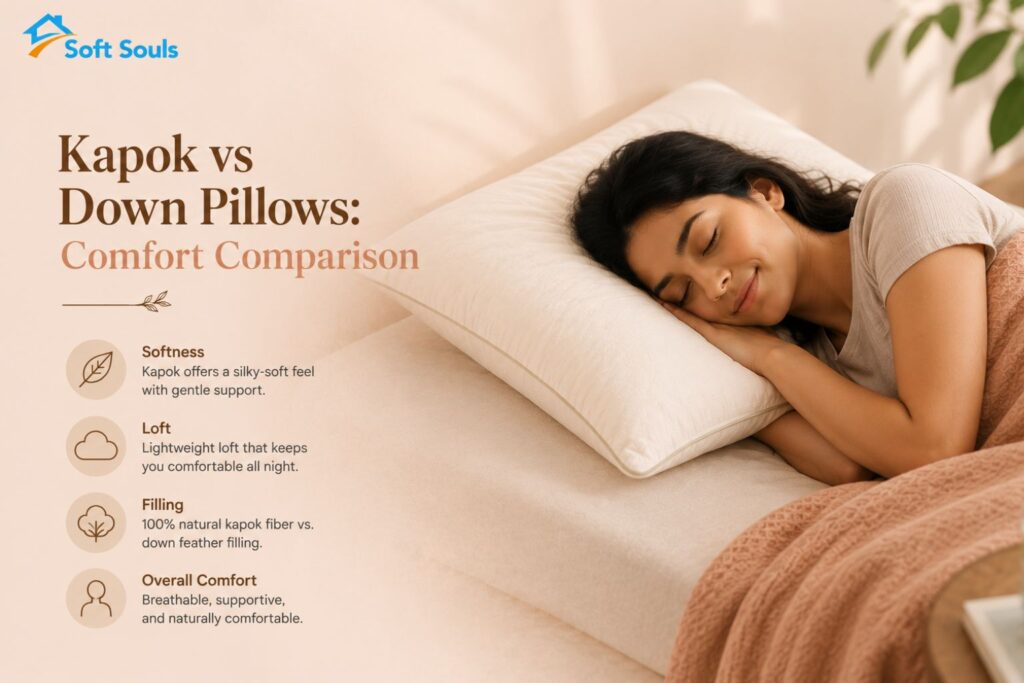
The kapok vs down pillows comparison is one of the more interesting ones in the natural sleep space. Both are natural materials. Both offer softness. But they come from entirely different sources, behave differently in warm weather, and serve different types of sleepers. This guide covers every meaningful dimension of that comparison.
What is Kapok Filling?
Kapok known as Illavam Panju in Tamil is a plant-based fibre harvested from the seed pods of the Ceiba pentandra tree. This tropical tree grows naturally in parts of South India, Southeast Asia, and Central America. When the pods ripen and burst, they release clusters of silky, cream-coloured fluff. That fluff is kapok.
The key physical property of kapok is that each fibre is hollow. Not just fine and lightweight actually hollow, like a tiny natural tube. This hollow structure is responsible for most of what makes kapok distinctive as a pillow filling:
- Air moves through the hollow interior and between fibres continuously creating natural ventilation
- The fibre is naturally moisture-resistant, meaning sweat does not cling to or penetrate the fill
- The lightweight, airy structure creates minimal compression under the head
- No chemical processing is required to make it functional as a fill material
As an organic pillow filling, kapok is plant-based, biodegradable, and harvested without cutting down trees. The pods are collected as they fall a sustainable harvesting method that has been practised in South Indian households for generations.
pillow Kapok benefits in everyday use include consistent breathability, lightweight feel, natural moisture resistance, and a silky, gently yielding surface that does not harden or compact the way synthetic alternatives do.
What is Down Filling?
Down is the soft underfeathers of birds typically geese or ducks found beneath the outer layer of stiffer feathers. These clusters of fine filaments trap air within their structure, creating insulation that keeps birds warm in cold water and cold air.
This insulating property is exactly why down became the material of choice for luxury pillows in cooler climates. A well-filled down pillow has a cloud-like loft that compresses gently under the head and slowly springs back. The down pillow comfort experience is soft in a way that few other natural materials replicate.
Down is measured in fill power the higher the fill power, the more air a given weight of down traps, and the loftier the pillow. High fill power down (600+) creates a pillow that is simultaneously light and generously lofted.
The trade-offs of down are also worth understanding upfront:
- Down is an animal product raising ethical and sustainability questions
- It can trigger allergies in people sensitive to feather proteins
- It absorbs and retains moisture more than synthetic or plant-based alternatives
- It requires dry cleaning or specialist washing rather than regular machine washing
- In warm, humid conditions, it retains body heat more than its reputation suggests
For Indian conditions warm, often humid, and demanding on bedding materials these trade-offs carry more weight than they do in the cooler climates where down pillows earned their reputation.
Softness Comparison — Which Pillow Feels Softer?
This is a subjective question with a nuanced answer. Both kapok and down are soft. But the quality of their softness is different.
Down pillow comfort offers what most people think of when they hear the word “soft” a plush, yielding, cloud-like feel that gently envelops the head. High-quality down has a consistent, even softness that is immediately noticeable and has become the benchmark for luxury sleep comfort globally.
Kapok has a different kind of softness. It is silky rather than plush. The texture feels like fine, weightless fluff less voluminous than down but with a gentle, smooth surface quality that is easier on skin during prolonged contact. As a soft pillow for sleeping, kapok feels airy and light rather than dense and cushioned.
Which is “softer” depends on what kind of softness the sleeper prefers:
- For dense, plush cloud-like softness → down is the more traditional experience
- For a lighter, airier, silky softness → kapok delivers a different but genuinely comfortable feel
Neither is categorically better. They are different experiences that suit different preferences.
Loft and Fluffiness — Which Pillow Stays Fuller Longer?
Why does one pillow stay fluffy while another goes flat? Fill material and structure are responsible.
Down loft is impressive when fresh and well-maintained. High fill power down can maintain its loft for years with proper care which includes regular fluffing and specialist washing or dry cleaning. The problem is that down, when exposed to sustained moisture, can lose its loft and clump together. In humid Indian conditions, this is a realistic risk over time.
Kapok loft behaves differently. The hollow fibre does not compress into a solid mass the way down clusters can when wet. Regular hand-fluffing restores the airy structure of a kapok pillow effectively. It does not require specialist washing periodic sun-airing maintains the fibre’s natural properties and prevents the fill from compacting.
In sustained Indian humidity particularly during monsoon months kapok tends to maintain its functional loft more reliably than down, because the moisture-resistant fibre does not clump when exposed to ambient humidity.
Summary:
- Down: more impressive initial loft, but vulnerable to humidity and requires careful maintenance
- Kapok: lighter loft, more humidity-resilient, easier maintenance for Indian conditions
Breathability and Heat Management — Which Stays Cooler?
This is where the comparison becomes most relevant for Indian sleepers and where kapok pillow benefits diverge most clearly from down.
Down’s insulating property is its primary appeal in cold climates. But that same insulating structure clusters of filaments trapping air and creating a warm microenvironment means down retains body heat. In cool rooms with significant climate control, this is manageable. In warm Indian conditions, particularly in non-AC rooms or during summer, down becomes a thermal challenge.
Kapok’s hollow fibre works in the opposite direction. Instead of trapping air as insulation, the hollow structure allows air to circulate continuously through the fill. Heat generated near the head has a path out through the fibre network, through a breathable cotton cover, into the room. The pillow surface does not accumulate warmth the way down does.
As a breathable pillow India option for warm, humid conditions:
- Kapok manages heat through ventilation the hollow fibre actively allows heat to escape
- Down manages heat poorly in warm conditions its insulating structure works against you in Indian summers
The moisture dimension adds to this difference. Kapok’s natural moisture resistance keeps the fill dry even in humid conditions. Down absorbs and retains moisture from both sweat and ambient humidity which in Indian monsoon conditions can create a heavier, warmer, slightly damp pillow over time.
For Indian sleepers particularly those without strong AC or those who sleep warm kapok is the more practical choice for breathability and heat management. Down is better suited to cooler climates or well-controlled AC environments.
Neck Support — Which Pillow Supports Better?
Is softness always better for sleep comfort? Not when it comes to cervical support.
Both kapok and down pillows tend toward the softer end of the support spectrum. Neither provides the firm, structured support of memory foam or latex. For sleepers who need significant neck elevation and alignment certain side sleepers with wider shoulders or people recovering from neck issues neither may be the first recommendation.
That said, there are differences within the soft category:
Down compresses readily under the weight of the head. It provides a soft, cushioned feel but limited pushback. For side sleepers, high fill power down can provide adequate loft, but the compressibility means the head often sinks lower than the neutral cervical position over the course of a night.
Kapok is slightly more resilient. The hollow fibres do not compress into as solid a mass as down clusters do. There is a gentle, light resilience that provides soft support without total collapse. Many kapok pillows also allow filling to be adjusted adding or removing fibre to customise the loft and firmness for individual needs.
Summary:
- Down: softer, more compressible, better for stomach sleepers and people who prefer minimal resistance
- Kapok: slightly more resilient, adjustable fill options available, more versatile across sleep positions
Allergy Considerations
Down allergies are a real and widely reported issue. Feather proteins can trigger reactions in people with sensitivities ranging from mild sneezing and nasal congestion to more pronounced respiratory responses. Dust mites also tend to accumulate in down fill more readily than in natural plant-based alternatives.
Kapok, as a plant-based organic pillow filling, carries none of the feather proteins that trigger down allergies. The fibre is also naturally resistant to dust mite accumulation compared to both down and synthetic polyester fill. For people who wake up with congestion, sneezing, or itchy eyes and attribute it to dust or allergies a kapok pillow is a more considered choice.
Summary:
- Down: potential allergy risk from feather proteins and dust mite accumulation
- Kapok: plant-based, naturally hypoallergenic, lower dust mite affinity
Durability and Maintenance
Down requires careful maintenance to preserve its loft and prevent clumping. Washing should be done gently in a large drum machine or by specialist dry cleaning. It needs to be dried thoroughly at low heat inadequate drying leads to clumping and potential mould in the fill. Fluffing should be done daily. Done correctly, high-quality down can last 5–10 years. Done incorrectly, it compresses, clumps, and loses its loft within months.
Kapok is easier to maintain in Indian conditions. The hollow fibre does not require machine washing the fill can be spot-cleaned and periodically sun-aired, which refreshes the fibre and maintains the airy structure. The cover is machine washable. The fill itself, when cared for with regular fluffing and occasional sun-airing, maintains its functional properties for several years.
In Indian conditions where regular washing is necessary and drying can be inconsistent during monsoon kapok’s maintenance requirement is more practical than down’s.
Summary:
- Down: high maintenance, requires specialist washing, vulnerable to improper drying
- Kapok: easier maintenance in Indian conditions, sun-airing instead of machine washing for fill
Sustainability Comparison
Down raises genuine ethical and environmental questions. Commercial down production involves large-scale poultry farming, with associated land use, water consumption, and in some supply chains animal welfare concerns around live plucking. Responsibly Sourced Down (RDS) certification exists, but is not universal or consistently enforced.
Kapok is a plant-based, renewable material harvested from naturally falling seed pods. The trees are not cut down. The harvesting process requires minimal energy and no industrial processing. The fibre is biodegradable at end of life, unlike synthetic fill. As an organic pillow filling choice, kapok has a significantly lower environmental footprint than either down or polyester.
For eco-conscious Indian buyers for whom sustainable sourcing is a consideration, kapok is the more straightforward choice.
Cost Effectiveness
High-quality down pillows command a significant price premium, particularly products with high fill power (600+) from ethically certified sources. Entry-level down products are cheaper but compromise on loft retention, durability, and ethical sourcing.
Kapok pillows are generally more accessible in price while delivering consistent performance in the conditions most relevant to Indian buyers. The lower maintenance requirement also reduces long-term cost no specialist washing, no replacement fill required as frequently.
For Indian households looking for a natural sleep pillow that delivers practical value across Indian weather conditions without luxury pricing, kapok offers a more accessible entry point.
Kapok vs Down Pillows: Side-by-Side Comparison Table
| Category | Kapok Pillow | Down Pillow |
| Material Source | Plant-based hollow fibre from Ceiba tree | Soft underfeathers of geese or ducks |
| Softness Level | Silky, light, airy softness | Plush, cloud-like, dense softness |
| Loft Retention | Moderate loft, humidity-resilient, easy to maintain | High initial loft, vulnerable to moisture and humidity |
| Breathability | Excellent hollow fibre allows continuous airflow | Poor in warm conditions insulating structure retains heat |
| Support | Gentle, light resilience; adjustable fill in some products | Soft and compressible; limited pushback under head weight |
| Heat Management | Low heat retention suited to warm Indian weather | High heat retention suited to cooler climates |
| Sustainability | Renewable, plant-based, biodegradable, low environmental footprint | Animal-derived, ethical sourcing variable, not biodegradable |
| Maintenance | Sun-air fill periodically; machine wash cover | Specialist washing or dry cleaning required |
| Allergy Friendliness | Naturally hypoallergenic, low dust mite affinity | Risk of feather protein allergies, higher dust mite accumulation |
| Suitability for Indian Weather | Excellent designed for tropical conditions | Limited performs better in cool, dry climates |
| Cost | More accessible price point | Premium pricing for high-quality options |
Who Should Choose Kapok? Who Should Choose Down?
Choose Kapok If:
- You sleep warm or sweat during sleep
- Your bedroom is not strongly air-conditioned
- You live in a warm, humid Indian city
- You have dust allergies or feather sensitivities
- You prefer plant-based, eco-friendly materials
- You want easy, practical maintenance
- You are looking for a breathable pillow India option for everyday use
Choose Down If:
- You sleep in a consistently cool, well-controlled AC environment
- You prioritise plush, cloud-like softness above other qualities
- You have no feather allergies
- You are comfortable with specialist maintenance and careful washing
- You prefer a traditional luxury pillow experience
- Breathability in warm conditions is a lower priority
Practical Buying Guidance
For Kapok Pillows:
Confirm 100% pure fill. Kapok blended with polyester is not equivalent to pure kapok in breathability or moisture management. Look for clear “100% kapok” or “100% Illavam Panju” labelling.
Check the cover fabric. A breathable organic cotton cover complements the hollow fibre fill. A synthetic cover reduces surface breathability. Medium-weave cotton is practical for Indian conditions year-round.
Assess loft and firmness options. Some kapok pillows allow fill adjustment. For side sleepers needing more neck support, a fuller fill or adjustable option is worth seeking.
Confirm washability of cover. The cover should be removable and machine washable. The fill is maintained through fluffing and periodic sun-airing not machine washing.
For Down Pillows:
Check fill power. 600+ fill power provides good loft retention. Lower fill power down compresses faster and provides less consistent support.
Look for ethical sourcing certification. Responsible Down Standard (RDS) or similar certification confirms humane sourcing. Not all down products carry this.
Budget for maintenance. Down pillows require proper care to last. Budget for specialist washing or dry cleaning as part of the total cost.
Consider your climate. Down performs best in cool, dry, well-controlled environments. For Indian weather without strong AC, the heat and moisture management trade-offs are significant.
Soft Souls — Natural Kapok Comfort for Indian Homes
For those ready to try a genuine kapok vs down pillows comparison in practice and looking for a kapok option built specifically for Indian conditions Soft Souls (softsouls.in) is a brand worth knowing.
Soft Souls is an Indian sleep brand that handcrafts pillows using 100% pure natural Kapok (Illavam Panju) fibre wrapped in breathable organic cotton fabric. Every pillow is made by Indian artisans who combine traditional craftsmanship with practical everyday design focused on the heat, humidity, and daily comfort demands of Indian bedrooms.
Their natural kapok range includes:
- Standard and queen-size kapok pillows 100% pure Kapok fill, lightweight, airy, naturally hypoallergenic, dust-mite resistant, and free from synthetic residues; designed for consistent breathability in Indian weather
- Kids kapok pillow range Illavam Panju fill in organic cotton covers, gentle for children’s sensitive skin, suitable for warm climates year-round
- Organic cotton pillow covers and pillowcases breathable cotton covers and mulberry silk pillowcases for a complete natural sleep setup
- Organic cotton bedsheet collections GOTS-certified, plant-dyed, completing the organic sleep environment
As a sustainable, local Indian brand committed to organic pillow filling that performs in actual Indian conditions, Soft Souls offers a transparent, honest alternative for sleepers considering the move from synthetic or conventional bedding to a more natural sleep surface.
For Indian buyers evaluating kapok vs down pillows who want a genuine natural option without the maintenance complexity or climate incompatibility of down Soft Souls provides a practical and reliable starting point.
Conclusion
The kapok vs down pillows comparison does not have a single winner. It has a clear answer depending on what the sleeper actually needs.
Down delivers an unmatched plush, cloud-like softness and impressive loft when maintained properly in cool, dry conditions. It is a premium experience suited to cool climates, climate-controlled bedrooms, and sleepers who prioritise softness above all else.
Kapok delivers consistent breathability, natural moisture resistance, lightweight comfort, and eco-friendly credentials that align closely with what Indian weather conditions demand. As a natural sleep pillow for a country where warmth and humidity are present for most of the year, it performs more reliably in everyday Indian conditions than down does.
For Indian sleepers comparing these two materials honestly the kapok pillow benefits of airflow, moisture resistance, plant-based sourcing, and easy maintenance make it the more practical choice for most people sleeping in most Indian bedrooms most nights of the year.
FAQ
Are kapok pillows softer than down pillows?
In the kapok vs down pillows comparison, down typically offers a denser, plush softness that most people associate with luxury pillows. Kapok has a different softness lighter, silkier, and airier. Neither is objectively better. If cloud-like, yielding softness is the priority, down edges ahead. If a lighter, gentler surface feel suits you better, kapok is equally satisfying. The key difference is that kapok’s softness does not come with down’s heat retention trade-off in Indian weather.
Which pillow is better for hot sleepers?
Kapok is notably more practical for hot sleepers. Kapok pillow benefits for heat management come from the hollow fibre structure, which allows continuous airflow through the fill heat escapes rather than accumulating near the head. Down’s insulating property, while valuable in cold climates, works against warm sleepers by retaining body heat. As a breathable pillow India option for warm weather, kapok consistently outperforms down in hot, humid Indian conditions, particularly without strong air conditioning.
Can kapok replace down pillows?
Yes, for most Indian sleepers. Kapok does not replicate the dense plush loft of high fill power down but it offers comparable softness of a different kind, significantly better breathability, lower maintenance, and better performance in warm conditions. For the cool climate luxury experience that down excels at, there is no direct replacement. But for a natural sleep pillow suited to Indian weather with practical daily maintenance, kapok is a complete and capable alternative.
Are kapok pillows suitable for Indian weather?
Yes more so than down. Kapok pillow benefits align closely with what Indian conditions demand: breathability in heat, moisture resistance in humidity, and lightweight comfort across warm months. Down’s insulating properties, which make it desirable in European or North Indian winters, become a liability in the prolonged warm, humid conditions across most of India’s geography. A breathable pillow India option like kapok handles Indian weather year-round more reliably than down does.
Which pillow retains loft longer?
This depends on conditions. In cool, dry environments with proper maintenance, high fill power down retains impressive loft for years. In warm, humid Indian conditions particularly during monsoon months down’s loft can suffer as the fill absorbs ambient moisture and begins to clump. Kapok’s moisture-resistant hollow fibre maintains its functional loft more reliably in Indian humidity. With regular fluffing and periodic sun-airing, a kapok pillow holds its airy structure consistently across Indian seasons without specialist care.