Introduction
Many sleepers in India know the feeling well a pillow that feels comfortable at 10 pm and uncomfortably warm by 1 am. Synthetic pillow materials trap body heat, and in a country where summer nights are rarely cool and humidity lingers through the monsoon months, this is not a minor inconvenience. It is a nightly disruption.
The kapok vs memory foam pillow comparison has become increasingly relevant for this reason. Memory foam was once considered a premium sleep upgrade contouring, supportive, long-lasting. But in Indian conditions, its tendency to retain heat has made many sleepers reconsider. Kapok, a natural plant-based filling used in Indian homes for generations, offers a different set of advantages: lightweight, breathable, and cooler under the head.
This guide breaks down both materials honestly what each does well, where each falls short, and which suits Indian sleeping conditions more practically.
What Is the Difference Between Kapok and Memory Foam Pillows?
The core difference is in the material itself.
Memory foam is a synthetic material polyurethane-based, viscoelastic, designed to respond to body heat and pressure. It contours to the shape of the head and neck, which many people find supportive. The trade-off is density: memory foam is compact, and that density limits airflow.
Kapok is a natural plant fibre harvested from the seed pods of the Kapok tree (Ceiba pentandra), known in Tamil Nadu and Kerala as Ilavam Panju or Silk Cotton. The fibre is hollow at its core, which gives it a naturally light and airy feel. It has been used as pillow and mattress filling across South and Southeast Asia for centuries.
In short: memory foam is engineered for contouring and support; kapok is naturally lightweight and breathable. For Indian weather, that difference matters considerably.
What Makes Kapok a Natural Sleep Pillow?
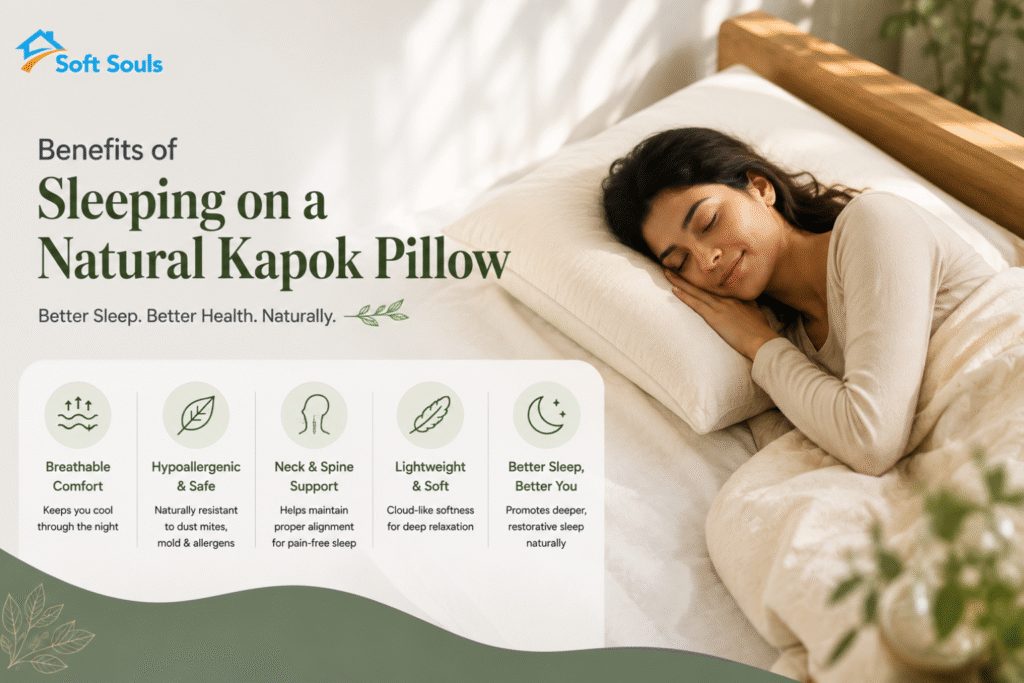
Kapok pillow benefits come directly from the fibre’s natural structure. The hollow core of each kapok fibre creates built-in airflow air circulates through the fill rather than being trapped inside it.
Here is what that means practically:
- Lightweight feel kapok is significantly lighter than memory foam, reducing that heavy, pressed-down feeling under the head
- Natural breathability the hollow fibre allows heat to escape, keeping the pillow surface cooler through the night
- Moisture management kapok absorbs light moisture and releases it, rather than retaining sweat against the skin
- No synthetic chemicals as a natural sleep pillow, kapok carries no polyurethane compounds, off-gas risks, or chemical residues
- Adjustable fill most kapok pillows allow the filling to be added or removed to suit sleeping preference, which foam cannot do
- Eco-friendly kapok is a renewable, biodegradable natural resource, harvested without pesticides in most traditional production methods
For an organic pillow for hot weather, kapok is one of the more practical natural options available particularly in India where the material is locally known and traditionally trusted.
How Does Memory Foam Work And What Are Its Drawbacks?
Memory foam responds to pressure and body heat. As the head rests on it, the foam softens slightly and moulds to the shape of the neck and skull. This contouring is the feature most memory foam users value it supports the cervical spine in a way that loose-fill pillows cannot always replicate as precisely.
But the same density that enables contouring creates memory foam pillow problems in warmer climates:
- Heat retention the dense foam traps body heat. Why does memory foam sometimes feel hotter during summer? Because there is nowhere for the heat to go. The foam simply holds it.
- Poor airflow the compact structure blocks air circulation, turning the pillow surface into a warm, enclosed space
- Off-gassing when new most memory foam products have a noticeable chemical odour when unpacked, from the polyurethane and additives in the foam. This fades over weeks but is a real concern for sensitive users.
- Weight memory foam pillows are noticeably heavier than natural alternatives, which some sleepers find uncomfortable
- Slow recovery in cold memory foam stiffens in cooler temperatures, changing its feel between seasons
- Compression over time despite marketing claims, most memory foam pillows lose their loft and response within two to three years of daily use
Can natural pillow materials actually improve sleep comfort where memory foam falls short? For Indian weather specifically, the evidence points toward yes particularly on the question of heat.
Which Pillow Stays Cooler During Indian Summers?
Kapok by a meaningful margin.
The hollow fibre structure of kapok allows air to move through the fill continuously. There is no dense material blocking heat from escaping. A breathable pillow India made from kapok stays noticeably cooler through the night compared to memory foam, which begins retaining heat from the first hour of contact.
Even expensive ACs and ceiling fans do not fully solve the pillow heat problem, because the heat source is the body itself. A dense synthetic fill holds that heat in place regardless of room temperature. A natural, breathable fill disperses it.
For homes without AC or anyone who sleeps warm by nature this difference is felt every night.
Are Memory Foam Pillows Too Hot for Indian Weather?
For many Indian sleepers, yes. The memory foam pillow problems in warm and humid conditions are well-documented: heat accumulation, sweat retention, and that unpleasant warm-to-the-touch feeling that builds over a few hours.
This does not mean memory foam has no place in India. For sleepers in air-conditioned rooms who prioritise neck support above all else particularly those with cervical issues memory foam’s contouring may outweigh its heat drawbacks.
But for the majority of Indian households, where nights are warm for most of the year and AC use is intermittent, the heat-retaining properties of memory foam are a consistent comfort problem rather than an occasional inconvenience.
Kapok vs Memory Foam: Full Comparison Table
| Feature | Kapok Pillow | Memory Foam Pillow |
| Breathability | High hollow fibres allow constant airflow | Low dense structure blocks airflow |
| Heat Retention | Low disperses body heat naturally | High absorbs and holds body heat |
| Comfort Feel | Light, soft, airy | Dense, contouring, pressure-sensitive |
| Weight | Light easy to adjust and move | Heavy noticeably denser |
| Support Level | Moderate adjustable with fill amount | High contours to head and neck shape |
| Sweat Comfort | Absorbs and releases moisture | Retains moisture in dense foam |
| Maintenance | Hand or machine washable | Spot clean only; cannot be submerged |
| Chemical Exposure | None 100% natural fibre | Polyurethane compounds; off-gassing when new |
| Sustainability | Renewable, biodegradable | Synthetic; non-biodegradable |
| Indian Climate Suitability | High breathable and cool for humid nights | Moderate suited to AC rooms primarily |
| Adjustability | Fill can be added or removed | Fixed structure; not adjustable |
| Lifespan | Several years with care | 2–3 years before noticeable compression |
| Price Range (India) | Affordable natural material | Mid to high engineered foam |
Which Pillow Suits Different Types of Sleepers?
Sleepers Without AC
A breathable pillow India option like kapok suits this group well. The breathable fill prevents heat from building up overnight, which is the primary discomfort concern in rooms that rely on fans.
Side Sleepers
Memory foam has an advantage here. Side sleeping requires more loft and neck support to keep the spine aligned. Kapok’s fill can be adjusted to achieve this, but memory foam provides it more consistently without adjustment.
Back Sleepers
Both work reasonably well. Kapok with a moderate fill loft suits back sleepers comfortably. Memory foam contours well but may feel too warm in Indian summers.
Stomach Sleepers
Kapok is generally more comfortable for stomach sleepers because of its lighter, flatter profile. Memory foam can feel too dense and elevated for this position.
Heavy Sweaters
Kapok is the more practical choice. As an organic pillow for hot weather, kapok manages sweat passively absorbing and releasing moisture rather than trapping it. Memory foam’s dense structure holds moisture and remains damp longer.
People With Cervical or Neck Issues
Memory foam’s contouring support is worth considering here specifically for those advised by a physiotherapist to use a contoured or orthopaedic pillow. Kapok’s fill can be built up but does not contour to the neck in the same way.
Why Are Natural Pillows Becoming More Popular?
Several practical reasons converge here.
Awareness of memory foam pillow problems particularly heat retention and chemical off-gassing has grown. At the same time, kapok pillow benefits are being rediscovered by a generation that grew up sleeping on synthetic fills and is now returning to what traditionally worked in Indian climates.
There is also a sustainability dimension. Memory foam is synthetic, non-biodegradable, and energy-intensive to produce. Kapok is harvested naturally, biodegrades fully, and has been used sustainably across South Asia for generations. For sleepers thinking about long-term material choices, a natural sleep pillow like kapok makes straightforward sense.
How to Choose the Right Pillow in India?
A few practical questions help narrow it down:
Does the room have consistent AC throughout the night? If yes, memory foam’s contouring support becomes a more viable option. If no, kapok is the more comfortable choice for Indian conditions.
Is neck support the primary concern? Memory foam contours more precisely. A well-filled kapok pillow provides good support, but for medically advised neck support, memory foam may be more appropriate.
Is breathability and sweat comfort the priority? Kapok wins clearly. A breathable pillow India made from natural kapok manages both heat and moisture better in Indian conditions.
Is chemical exposure a concern? Kapok contains none. Memory foam, particularly when new, carries off-gassing compounds. For sensitive users, children, or anyone with respiratory concerns, kapok is the cleaner option.
What is the budget? Natural kapok pillows are generally more affordable than quality memory foam options in India, without compromising on comfort for the climate.
Soft Souls: Kapok Pillows Made for Indian Weather
Soft Souls is an Indian brand that has built its sleep product range specifically around natural, breathable comfort. Their Kapok pillow line made from 100% organic Ilavam Panju (Silk Cotton/Kapok) filling is one of the more carefully sourced natural pillow options available in the Indian market.
The pillows are described as “natural, breathable, and eco-friendly pillows for better sleep” and the construction backs this up. The Kapok filling is harvested from natural sources without synthetic processing, and the outer cover uses breathable cotton fabric that complements the fill’s natural airflow properties.
What makes Soft Souls’ approach relevant in the kapok vs memory foam pillow conversation:
- 100% organic Kapok filling no polyurethane, no synthetic blends, no foam components
- Breathable cotton outer cover keeps the sleep surface cool and gentle on skin
- Designed for Indian weather the brand explicitly positions its products around India’s climate: heat, humidity, and the need for lighter, cooler sleep surfaces
- Eco-friendly sourcing Kapok is a renewable natural resource; Soft Souls’ use of it as a primary fill aligns with a lower-impact sleep product
- Range includes kids’ pillows natural fill pillows for children, where avoiding chemical exposure is especially important
- Accessible pricing the brand positions natural pillow comfort as an everyday choice, not a premium one
For anyone on the kapok pillow benefits side of this comparison and looking for a starting point, Soft Souls’ Kapok range offers a practical, Indian-weather-appropriate option without the premium pricing that natural bedding products sometimes carry.
Conclusion
The kapok vs memory foam pillow comparison does not have a single universal answer but it does have a clearer answer for Indian conditions.
Memory foam provides reliable contouring support and suits sleepers in consistently air-conditioned rooms who prioritise neck alignment. For that specific use case, it remains a reasonable choice.
For the majority of Indian sleepers dealing with warm nights, intermittent or no AC, humidity, and heat buildup on the sleep surface kapok pillow benefits align more directly with daily comfort needs. A natural sleep pillow that breathes, manages sweat, stays cooler, and carries no chemical residues is a more practical fit for the climate.
The memory foam pillow problems in Indian weather primarily heat retention and poor airflow are not incidental. They are structural properties of a dense synthetic material in a warm, humid environment. Kapok’s natural hollow fibre simply handles these conditions better.
Choose based on actual sleeping conditions, not marketing. In Indian summer, a breathable pillow India made from kapok is likely to deliver more consistent nightly comfort.
FAQs Is kapok better than memory foam for hot weather?
For hot and humid conditions, kapok has a clear practical advantage in the kapok vs memory foam pillow comparison. Kapok’s hollow fibres allow continuous airflow, keeping the surface cooler through the night. Memory foam’s dense structure retains body heat, which becomes uncomfortable in warm Indian nights. Kapok pillow benefits particularly breathability and moisture management — make it a more suitable choice for sleepers who deal with heat regularly.
Why do memory foam pillows feel warm at night?
Memory foam responds to body heat by softening and contouring. The same property that makes it supportive also makes it heat-retaining the dense foam absorbs warmth from the head and neck and holds it in place. There is limited airflow through the compact structure, so the heat does not escape easily. This is one of the most commonly reported memory foam pillow problems among Indian users, especially during summer months.
Are kapok pillows good for neck support?
They provide moderate, adjustable support. Unlike memory foam, which contours precisely, a natural sleep pillow filled with kapok maintains a consistent loft that can be adjusted by adding or removing filling. For most casual sleepers, this is sufficient. For those with diagnosed cervical issues who need specific contouring, memory foam may offer more targeted support though the heat trade-off remains.
Which pillow is better for sweaty sleepers?
Kapok is more practical for this concern. A breathable pillow India made from organic kapok absorbs light moisture and releases it naturally, keeping the surface drier through the night. Memory foam, being dense and non-porous, holds moisture and stays damp longer after sweating. For people who sleep warm or live in humid climates, this difference is felt clearly.
Are natural pillows healthier for sleep?
For most people, yes particularly in terms of chemical exposure. Memory foam contains polyurethane compounds that off-gas when new and are synthetic by nature. Kapok is a plant fibre with no chemical processing, no synthetic blends, and no off-gassing. An organic pillow for hot weather like kapok removes chemical exposure from a surface in contact with the face for several hours nightly a practical health consideration that synthetic alternatives cannot match.
Are kapok pillows cooler than memory foam pillows?
Yes. Kapok’s hollow fibre structure allows heat to escape naturally, while memory foam retains body warmth and often becomes noticeably warm within an hour of use.
Which pillow is better for humid weather?
Kapok handles humidity more comfortably it absorbs light moisture and releases it rather than holding it, keeping the sleep surface drier in humid conditions.