Introduction
Modern Sleep Is Getting Worse, Not Better
Something slightly ironic is happening in Indian homes. More people have AC units than ever before. Expensive mattresses are being sold at record numbers. Sleep tracking apps are downloaded by the millions. And yet, the number of people who wake up feeling unrested, overheated, or uncomfortable is climbing rather than falling.
Part of the answer is hiding in plain sight the pillow.
Synthetic pillows, which fill most Indian bedrooms today, are built from polyester fibres or foam that trap body heat, hold onto sweat, and create a warm, slightly damp surface by the middle of the night. No amount of AC can fully fix what the pillow material is doing three centimetres from your face.
This is one reason organic sleep pillows made from natural materials like kapok are getting more attention. Not as a trend or novelty but as a straightforward answer to a material problem. The organic bedding trends moving through Indian cities are not about aesthetics. They are about people wanting sleep that actually works for the conditions they sleep in.
Why Are People Moving Away from Synthetic Bedding?
Can a pillow actually affect long-term sleep quality? The more sleep research accumulates, the clearer it becomes that yes materials matter.
Synthetic pillows have a specific set of problems that become more obvious in Indian conditions:
- Heat trapping Polyester and foam do not allow heat to escape. Body warmth accumulates near the head and neck and stays there through the night.
- Sweat discomfort Synthetic fill absorbs moisture slowly and releases it even more slowly. The pillow becomes warm and damp, and stays that way.
- Chemical exposure Standard synthetic pillows are often treated with flame retardants, synthetic dyes, and VOC-emitting materials. These are in contact with your face for 7–8 hours every night.
- Poor airflow Dense synthetic fill has no internal air circulation. There is no ventilation happening inside the pillow just compressed fibre holding heat.
- Short lifespan Polyester fill compresses, clumps, and flattens within a year or two of regular use. Foam can develop heat retention problems and off-gas more as it ages.
The shift toward eco-friendly bedding India households are beginning to make is not just about sustainability in an abstract sense. It is about people noticing, night after night, that synthetic materials are creating the exact problems they were supposed to solve.
What Makes Kapok Different from Regular Pillow Filling?
Kapok known as Illavam Panju in Tamil is a plant-based fibre harvested from the seed pods of the Ceiba tree. It grows naturally in tropical regions, including South India, and has been used as a pillow and mattress filling in Indian homes for generations before synthetic materials took over.
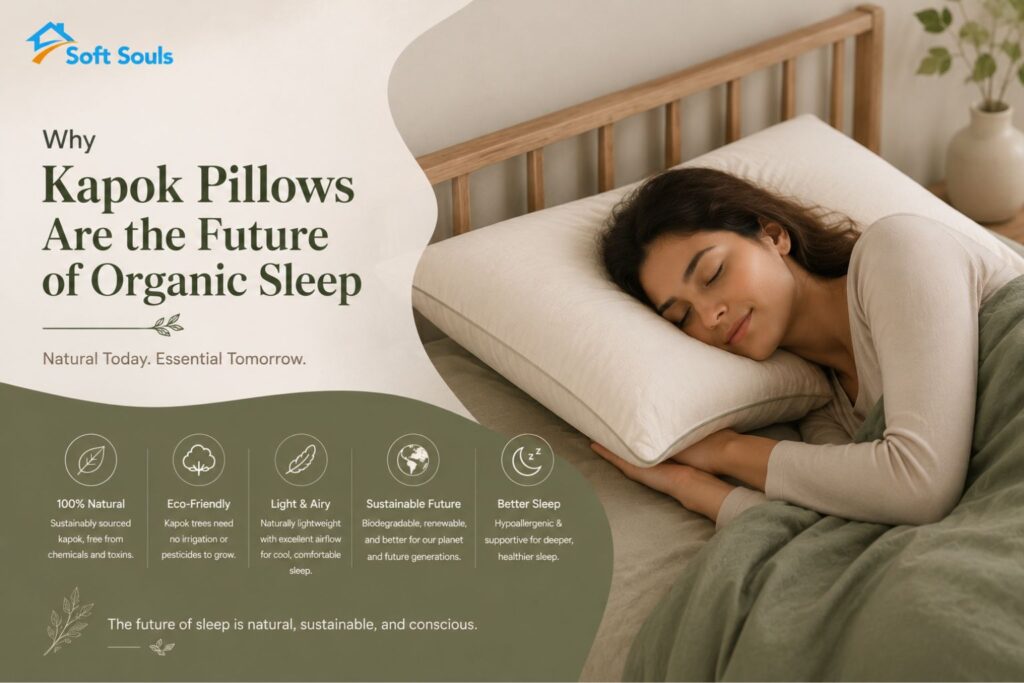
The defining characteristic of kapok fibre is that it is hollow. Each individual fibre is a tiny, naturally sealed tube. When these hollow fibres are loosely packed into a pillow, the space inside each fibre and between fibres creates a network of natural air channels. Air moves through this network continuously.
Compare this to polyester fill: solid synthetic strands compressed together with minimal space for air movement. Or memory foam: a solid block engineered specifically to compress and hold shape which is the same property that makes it trap heat so effectively.
As a natural sleep pillow, kapok works through physical structure rather than through chemical engineering. That structural advantage is what makes kapok pillow benefits consistent and measurable rather than marketing language.
Kapok Pillow Benefits What It Actually Delivers
The kapok pillow benefits that matter most for Indian sleepers are:
Breathability. The hollow fibre structure creates continuous airflow inside the pillow. Heat escapes. The surface stays cooler through the night. This is what a breathable organic pillow actually means in practice not a marketing claim, but a physical property.
Lightweight comfort. Kapok is one of the lightest natural filling materials available. A full-sized kapok pillow weighs noticeably less than its polyester equivalent. Less weight means less pressure on the head and neck, which improves circulation and reduces localised heat at the contact point.
Natural moisture resistance. Kapok fibre has a waxy natural coating that repels rather than absorbs moisture. Sweat does not accumulate inside the fill. The pillow surface stays drier on warm, humid nights.
Chemical-free sleeping surface. Plant-based and minimally processed, genuine kapok fill carries none of the synthetic residues that conventional pillows do. For a surface in contact with your face every night, this matters more than it is usually given credit for.
Softness that holds. The silky texture of kapok fibre provides a soft, gently yielding surface that does not compress into a hard lump the way polyester fill does over months of use.
Are Kapok Pillows Suitable for Indian Weather?
This is where the case for kapok becomes particularly strong.
Indian weather is warm for most of the year and humid across large parts of the country. The conditions that make synthetic pillows most uncomfortable sustained heat, ambient humidity, and active sweating during sleep are exactly the conditions kapok handles well.
The hollow fibre allows warm air generated near the head to escape through the fill rather than accumulating. The moisture-resistant surface stays drier in humid conditions. The lightweight structure creates less pressure and therefore less body heat at the contact point.
For eco-friendly bedding India homes dealing with summers in Chennai, Hyderabad, Mumbai, or Nagpur, a breathable organic pillow made from kapok is suited to the climate in a way that memory foam and polyester simply are not. Those materials were developed for and tested in cooler, drier conditions. Kapok was used in tropical Indian homes because it performed well there.
Kapok Pillow vs Regular Synthetic Pillow
| Feature | Kapok / Organic Sleep Pillow | Regular Synthetic Pillow |
| Breathability | Excellent hollow fibre creates continuous ventilation | Poor dense fill blocks internal airflow |
| Heat Retention | Low heat escapes through the natural air channels | High body heat is absorbed and held in place |
| Sweat Comfort | Moisture-resistant fibre, surface stays drier | Holds moisture, becomes progressively damp |
| Weight | Very lightweight minimal neck pressure | Heavier, especially foam and dense polyester |
| Chemical Exposure | Plant-based, minimal processing, no synthetic residues | Synthetic dyes, flame retardants, VOC materials |
| Lifespan | Durable with proper care fluffing maintains structure | Compresses and clumps, loses shape within 1–2 years |
| Indian Weather Fit | Well-suited designed for tropical conditions | Uncomfortable in sustained heat and humidity |
| Eco Impact | Renewable plant source, biodegradable fill | Non-renewable, non-biodegradable, industrial production |
Why Is Sustainable Bedding Becoming Important?
Why are more people moving away from synthetic bedding? Part of it is comfort. Part of it is something broader.
Polyester the fill in most standard pillows is derived from petroleum. Its production involves chemical processes that generate industrial waste and consume non-renewable resources. At the end of its short lifespan, it does not biodegrade. It adds to textile landfill, which is already one of the largest categories of global waste.
Kapok, by contrast, is harvested from pods that grow naturally on trees. The trees are not cut down the pods are collected when they fall. The fibre requires minimal processing. And at the end of its life, kapok breaks down naturally.
For Indian consumers who are beginning to think about what their purchasing decisions mean beyond the immediate purchase, this lifecycle difference is meaningful. Eco-friendly bedding India is not a niche movement anymore. It is part of a broader shift toward choosing products that do less damage to the environment without requiring a sacrifice in daily comfort.
Organic bedding trends in India reflect this shift. Searches for natural pillow materials, organic cotton bedding, and sustainable sleep products have been climbing consistently not because of fashion, but because people are connecting daily discomfort with material choices and starting to look for alternatives that perform better and cost less to the planet.
The Future of Organic Sleep in India
The direction is clear. Organic sleep pillows and natural bedding materials are moving from a niche category to a mainstream consideration driven not by lifestyle branding but by practical performance in Indian conditions.
A few factors are shaping this:
- Awareness of indoor chemical exposure More people are researching what is in their bedding and why it matters for long-term health
- Heat and humidity are getting worse Climate patterns are making the breathability of sleep materials more relevant, not less
- Traditional materials are being rediscovered Kapok (Illavam Panju), organic cotton, and natural fills are being revisited not out of nostalgia but because they work
- Quality is lasting longer A genuine natural fill pillow with proper care outlasts a polyester alternative, which changes the value calculation
The organic bedding trends visible in Indian metro cities are early indicators of a wider shift. As awareness spreads and natural sleep products become more accessible, the choice between synthetic and natural will increasingly become straightforward particularly for families with young children, people with skin sensitivities, and sleepers in hot, humid conditions.
How to Choose the Right Organic Sleep Pillow?
Confirm 100% natural fill. Kapok blended with polyester is not a kapok pillow in any meaningful sense. Look for clear labelling “100% kapok” or “100% Illavam Panju fill.”
Check the cover material. A synthetic cover cancels out the breathability of a natural fill. Organic cotton in a medium weave is the practical standard for Indian weather.
Assess loft and firmness. Kapok fill tends toward a softer, loftier feel. Side sleepers need more fill for neck support. Back and stomach sleepers typically find standard kapok loft comfortable.
Confirm washability. The cover should be removable and machine washable. Kapok fill itself does not require machine washing periodic sun-airing refreshes the fibre and maintains its structure.
Look for transparent brands. Any breathable organic pillow worth buying comes from a seller who clearly states what is inside, how it was made, and how to care for it. Vague “natural” claims without material disclosure are a flag worth noting.
Soft Souls — Organic Kapok Sleep for Indian Homes
For those looking for genuine organic sleep pillows made with Indian conditions and Indian materials in mind, Soft Souls (softsouls.in) is a brand worth knowing.
Soft Souls is an Indian sleep brand built around one clear commitment: honest materials for better everyday sleep. Every pillow is handcrafted by Indian artisans using 100% pure natural Kapok (Illavam Panju) fibre wrapped in breathable organic cotton fabric designed specifically for the heat, humidity, and daily sleep demands of Indian weather.
Their sustainable kapok range includes:
- Standard and queen-size natural kapok pillows 100% pure Kapok fill, lightweight, airy, naturally hypoallergenic and dust-mite resistant, completely chemical-free, and handmade for everyday Indian use
- Kids kapok pillow range Illavam Panju fill with organic cotton covers, gentle and breathable for children in warm climates
- Organic cotton pillow covers and accessories breathable cotton covers and mulberry silk pillowcases for a complete natural sleep setup
- Organic and Earth-Tone Naturals bedsheets GOTS-certified organic cotton bedding with plant-based dyes, completing the sustainable sleep environment
As an eco-friendly bedding India brand that supports local Indian artisans and uses sustainable, biodegradable materials, Soft Souls connects the organic bedding trends shaping Indian homes with products that are transparent, practical, and genuinely suited to Indian conditions.
For anyone ready to move toward organic sleep pillows that are honest about what is inside them, Soft Souls is a natural and reliable starting point.
Conclusion
The shift toward organic sleep pillows in India is not a passing interest. It is a response to a real and growing problem synthetic bedding that performs poorly in Indian weather, degrades quickly, carries chemical residues, and contributes to a landfill problem that does not go away.
Kapok is not a new solution. It is an old one being rediscovered for the right reasons. Its hollow fibre structure allows genuine breathability. Its plant-based origin makes it sustainable. Its performance in warm, humid conditions is consistent and well-documented by generations of Indian use.
A natural sleep pillow made from kapok is not a luxury. It is a practical, sustainable alternative to a category of product that was never well-suited to Indian sleeping conditions in the first place. The future of organic sleep in India is already underway and kapok is a meaningful part of where it is heading.
FAQ
Why are kapok pillows becoming popular?
Kapok pillows are gaining attention because they address the specific problems that synthetic pillows create in Indian weather heat retention, sweat discomfort, and poor airflow. As organic sleep pillows, they offer a natural, breathable alternative without any special engineering. The kapok pillow benefits lightweight feel, moisture resistance, and continuous airflow through hollow fibre are practical and consistent. Combined with growing awareness about chemical exposure in conventional bedding, more Indian sleepers are making the switch.
Are kapok pillows good for hot weather?
Yes. A breathable organic pillow made from kapok is specifically well-suited to hot weather. The hollow fibre structure allows heat to escape continuously rather than accumulating near the head. The natural moisture resistance keeps the surface drier during sweaty nights. For Indian summers which are prolonged and often humid these properties make a consistently noticeable difference compared to foam or polyester pillows, which are designed for cooler climates and perform poorly in heat.
What makes kapok pillows eco-friendly?
Kapok is harvested from naturally falling seed pods of the Ceiba tree the trees are not cut down. The fibre requires minimal processing compared to synthetic alternatives. At the end of its life, kapok is biodegradable, unlike polyester fill which persists in landfill for decades. As part of eco-friendly bedding India homes are increasingly considering, kapok represents a renewable, low-impact material that performs well in daily use rather than requiring any environmental trade-off.
Can kapok pillows improve sleep comfort?
Yes. Kapok pillow benefits for sleep comfort are specific and practical. Continuous airflow through the hollow fibre keeps the sleeping surface cooler. Natural moisture resistance reduces the damp, sticky feeling that builds up in synthetic pillows through warm nights. The lightweight fill creates less pressure on the head and neck. And the plant-based, chemical-free composition is gentler for skin with prolonged contact. Together, these properties produce a noticeably more comfortable sleeping experience in Indian conditions.
Are kapok pillows suitable for Indian summers?
Yes. Kapok is one of the most practical natural sleep pillow options for Indian summers. The hollow fibre handles heat and humidity simultaneously allowing airflow while resisting moisture accumulation. For non-AC homes especially, this makes a real difference: the pillow surface stays cooler and drier than any synthetic alternative through warm, humid nights. The material was used in South Indian homes for generations specifically because it performs well in tropical conditions and those conditions have not changed.